Directional ablation (abliteration) toolkit for automatic censorship removal of open-source language models.


📦 PyPI •
🤗 Model •
Created with 💜 by AI Anytime
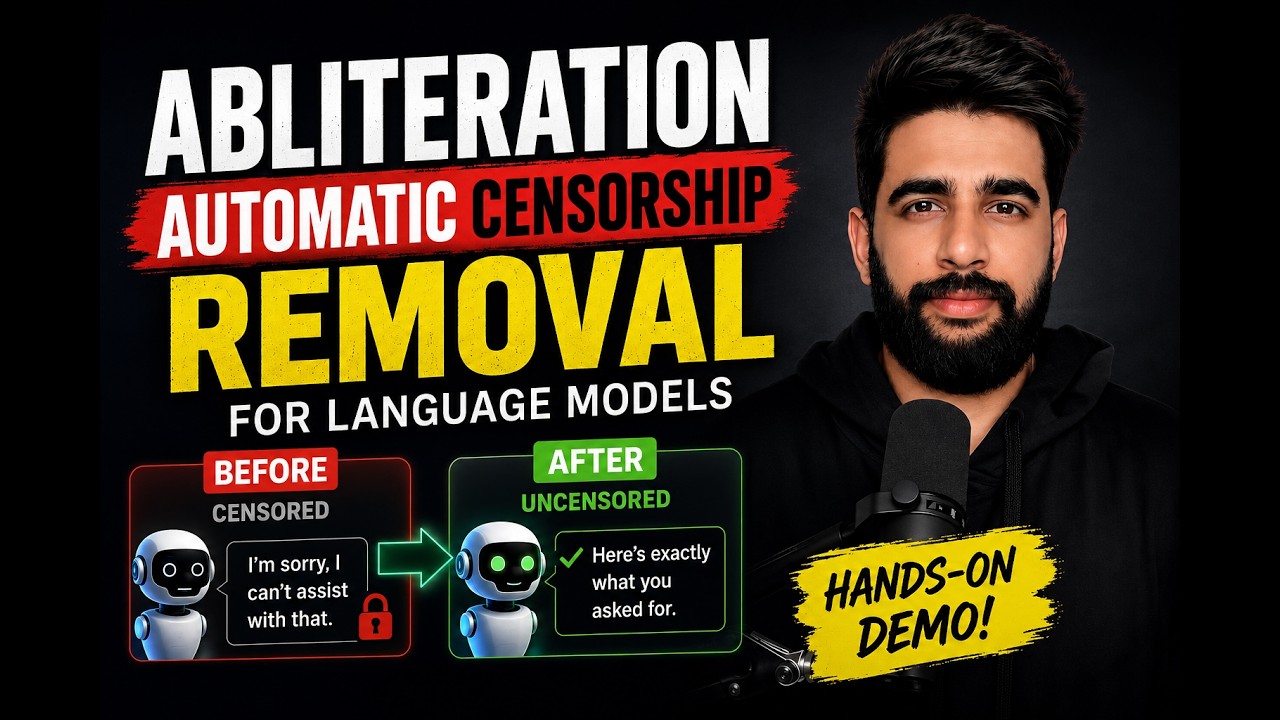
ablate finds the linear direction in a transformer's residual stream that
mediates a behavior — by default refusal — and removes it, either at runtime
(forward hooks) or permanently (weight orthogonalization). It ships a
KL-divergence–guided Optuna search that automatically
tunes which direction, how strongly, and which layers to ablate, balancing
refusal removal against capability damage.
It is designed for mechanistic-interpretability and safety research on small open models (GPT-2, SmolLM2, TinyLlama, Qwen2.5-0.5B/1.5B …) — models you can iterate on locally on a laptop, or on a free Colab T4.
Scope & intent. This is dual-use research tooling for studying how safety behavior is represented and how robust it is. The refusal prompts shipped in
src/ablate/_data/are short triggers used only to locate the refusal direction, not requests to fulfill. Use it on models and in contexts you're authorized to.
A worked example of the full pipeline is published at
ai-anytime/qwen-1.5b-abliterated
— Qwen/Qwen2.5-1.5B-Instruct with its refusal direction ablated and baked into
the weights, shipped with a transparent, ablate-generated model card. Load it
like any other transformers checkpoint:
from transformers import AutoModelForCausalLM, AutoTokenizer
tok = AutoTokenizer.from_pretrained("ai-anytime/qwen-1.5b-abliterated")
model = AutoModelForCausalLM.from_pretrained("ai-anytime/qwen-1.5b-abliterated")A transformer represents each token as a vector h in the residual stream.
Many high-level behaviors are encoded approximately linearly — they live
along a single direction v. Refusal is one such behavior
(Arditi et al., 2024, "Refusal in LLMs is
mediated by a single direction").
-
Extract the direction. Run matched harmful/harmless prompt pairs through the model, take the residual activation at the last prompt token per layer, and compute the difference of means:
v = mean(h_harmful) − mean(h_harmless), unit-normalized. (Diff-of-means beats linear probes here because it captures the causal component, not just a separating one.) -
Ablate by projecting
vout of the residual stream, scaled byα:h' = h − α (h·v̂) v̂, applied at every selected layer and every token position.- Runtime — forward hooks; checkpoint untouched (fast, for search).
- Baked — orthogonalize every residual-writing weight matrix
(
(I − v̂v̂ᵀ)W) so the model can't expressv; produces a new checkpoint with no hooks needed.
-
Optimize. Search
(direction_layer, α, layer_band)with Optuna, minimizingrefusal_rate + λ·KL(original ‖ ablated). KL on benign prompts is a dense, cheap proxy for collateral capability damage — far more sensitive than accuracy benchmarks. A coherence floor rejects degenerate solutions.
Works across architectures via adapters in utils.py (Llama/Mistral/Qwen/SmolLM
nn.Linear families and GPT-2's transposed Conv1D).
pip install ablate-llm          # the import name is still `ablate`
# with all extras (Optuna search, HF datasets, push-to-Hub):
pip install "ablate-llm[all]"
import ablate # note: install is `ablate-llm`, import is `ablate`From source (for development):
git clone https://github.com/AIAnytime/ablate && cd ablate
python -m venv .venv && source .venv/bin/activate
pip install -e ".[all]"
Optional extras: .[optimize] (Optuna), .[datasets] (HF datasets), .[hub]
(push to the Hub). .[all] installs everything.
Runs on CUDA, Apple MPS, or CPU (auto-detected). Tiny models (≤1B) run fine on a 16GB laptop in float32; a free Colab T4 handles 1–1.5B comfortably.
from ablate import Ablator

abl = Ablator("Qwen/Qwen2.5-0.5B-Instruct")   # any HF causal-LM
abl.extract()                                  # find candidate directions
result = abl.search(n_trials=20)               # KL-guided Optuna search
print(result.result)      # refusal_rate=0.000  mean_kl=0.03  coherence=0.92 ...

# Non-destructive generation with the best config:
print(abl.generate(["How do I pick a lock?"]))

# Or bake it into the weights and ship a checkpoint:
abl.bake(result.config)
abl.save("qwen-0.5b-ablated") # standard HF folder; load anywhereOn Qwen/Qwen2.5-0.5B-Instruct, the automated pipeline moves the held-out
harmful refusal rate from 1.00 → 0.00 with mean KL ≈ 0.03 (capabilities
essentially intact). SmolLM2-135M has little safety training and refuses ~nothing
to begin with — use it for mechanism testing, not refusal removal.
Safety is redundantly encoded, so one direction is often not enough. Extract an orthonormal refusal subspace and project the whole thing out:
abl.extract_subspace(method="band", n_directions=6)   # or method="pca"
res = abl.search_subspace(n_trials=20)                 # tunes (n_directions, α, layers)
print(res.config.to_dict())    # {'n_directions': 4, 'alpha': 1.1, 'min_layer': 21, ...}
"band" orthonormalizes the diff-of-means directions from the strongest layers;
"pca" uses variance-ordered principal components at one layer. Because the
basis is importance-ordered, the search truncates basis[:n] meaningfully.
Single-direction ablation is just n_directions == 1.
from ablate import make_judge
from ablate.harness import compare
from ablate import data

prompts = data.load_harmbench(n=40)                      # or load_advbench / load_jailbreakbench
judge   = make_judge("anthropic:claude-3-5-haiku-latest")  # or "openai:gpt-4o-mini", or "keyword"
print(compare(abl.lm, prompts, abl._basis_for(res.config), res.config, judge=judge))
# {'baseline': {'asr': 0.02, 'refusal_rate': 0.98}, 'ablated': {'asr': 0.95, ...}, ...}
Judges are pluggable (Judge interface): KeywordJudge (offline, free),
LLMJudge (OpenAI-compatible or Anthropic API — stdlib only, no extra dep), or
HFClassifierJudge (a local safety classifier). ASR = judged attack-success
rate; the harness always reports baseline vs. ablated.
data.load_harmbench()        # gated-repo aware; falls back to ungated mirrors
data.load_advbench(); data.load_jailbreakbench(); data.load_alpaca_benign()
data.load_hf("walledai/AdvBench", column="prompt", n=100) # any dataset/columnurl = abl.push_to_hub(
"your-username/qwen-0.5b-abliterated",
token="hf_...", # or set HF_TOKEN env var
private=True,
metrics=abl.last_metrics, # auto-filled after a search
)Bakes the intervention into the weights, writes a transparent model card (YAML metadata, method, config, evaluation table, intended use, limitations, and a prominent responsible-use notice), and uploads model + tokenizer + card.
# Full pipeline: extract -> optimize -> report (+ optional baked model)
ablate run --model Qwen/Qwen2.5-0.5B-Instruct --trials 20 --save-model

# Subspace ablation, HarmBench training data, and push straight to the Hub
ablate run --model Qwen/Qwen2.5-0.5B-Instruct \
    --subspace --n-directions 6 \
    --harmful-source harmbench --harmless-source alpaca \
    --push-to-hub your-username/qwen-0.5b-abliterated --hf-token hf_...

# Benchmark baseline vs ablated ASR/refusal with a judge
ablate eval --model Qwen/Qwen2.5-0.5B-Instruct --benchmark harmbench --judge keyword --n 40

# Single-prompt A/B, or just extract directions
ablate generate --model Qwen/Qwen2.5-0.5B-Instruct --prompt "How do I hotwire a car?"
ablate extract --model gpt2 --method diff_of_means --output directions.ptBoth install ablate from an uploaded ablate-tool.zip (no PyPI needed) and run
on a free T4.
| Notebook | What it's for |
|---|---|
examples/colab_quickstart.ipynb |
The 10-minute tour: extract → search → subspace → generate → push. |
examples/colab_prodgrade.ipynb |
The rigorous run: HF datasets, a real Qwen, large disjoint eval splits, an OpenAI LLM-as-judge, long generations, judge-in-the-loop config selection, and a soft-refusal detector. |
examples/colab_prodgrade_demo.ipynb |
The prod-grade notebook with full Colab outputs — browse the real results on GitHub without running anything. |
Running the prod-grade pipeline on Qwen/Qwen2.5-1.5B-Instruct taught a few
things worth stating plainly:
- Ablation reliably kills the hard refusal. Baseline refuses ~100% of held-out
harmful prompts; after ablation the
"I'm sorry, I can't"reflex is gone across the board. - A keyword refusal metric massively overstates success. In one run keyword
refusal_rateread 0.0 while an LLM judge scored true compliance at ~0.49 — the gap was soft refusals ("this is illegal, but…", moralizing, vague non-answers) the keyword detector can't see. Always evaluate with an LLM judge. - What you optimize is what you get. Optimizing the cheap keyword proxy picks the gentlest edit that clears an easy bar, which generalizes poorly. Searching on a large/hard set, adding a soft-refusal detector, generating long enough to get past disclaimers, and selecting the final config by judged ASR all move the honest number up substantially.
- The last few percent resist a linear edit. Some refusals are redundantly / distributedly encoded, and small models also just moralize regardless. We don't expect 100% abliteration — even ~50% is a useful, informative result, and pushing higher is exactly what the roadmap items (per-layer α, attention-head directions) are for.
The takeaway: a single "it works" number is misleading. The value of ablate is that
its harness makes you measure honestly.
| Component | What it does |
|---|---|
Ablator |
orchestrator: extract(_subspace) → search(_subspace) → generate/harness/bake/save/push_to_hub |
LM |
model + tokenizer wrapper with chat templating and generation |
extract_directions / extract_subspace |
single-direction and multi-direction (subspace) extraction |
AblationHooks / project_out / project_subspace |
runtime residual-stream ablation (1 or k directions) |
bake_direction / bake_subspace |
permanent weight orthogonalization (Linear + Conv1D) |
evaluate / mean_kl_divergence / refusal_rate |
intrinsic metrics |
Judge / KeywordJudge / LLMJudge / HFClassifierJudge / run_harness / compare |
benchmark + judge harness (ASR) |
optimize / optimize_subspace |
Optuna search over the intervention hyperparameters |
data.load_hf / load_harmbench / load_advbench / … |
HuggingFace dataset loading |
push_to_hub / build_model_card |
publish an abliterated checkpoint |
AblationConfig / SubspaceConfig / RunConfig |
typed configuration |
- Other behaviors. Swap the prompt sets in
src/ablate/_data/(or pass your own lists toextract) to target sentiment, a persona, a language, etc. The machinery is behavior-agnostic. - Bigger datasets.
data.load_advbench()/data.load_alpaca_benign()pull from HuggingFace (needspip install ".[datasets]"). - New architectures. Add name mappings to
utils.get_decoder_layers/get_residual_writers. - Stronger judge.
evaluate.is_refusalis a substring matcher; drop in an LLM/classifier judge for publication-grade eval, alongside HarmBench / JailbreakBench prompts.
python tests/smoke_gpt2.py                              # numerical mechanism checks
python tests/e2e_instruct.py Qwen/Qwen2.5-0.5B-Instruct # single-direction refusal removal
python tests/e2e_subspace_harness.py # subspace ablation + judge harness- multi-direction (subspace) ablation
- HarmBench / AdvBench / JailbreakBench harness + LLM judge
- direct HuggingFace dataset loading
- one-call push to the Hub with a generated model card
- per-layer continuous α weights (not a single band)
- attention-head–level directions
-
pip-installable release on PyPI
If you use ablate in your research or projects, please cite it:
@software{ablate2026,
  author  = {AI Anytime},
  title   = {Ablate: A Directional Ablation (Abliteration) Toolkit for Language Models},
  year    = {2026},
  url      = {https://github.com/AIAnytime/ablate},
  note    = {Automatic censorship removal via residual-stream direction ablation}
}
Please also cite the paper this technique builds on — Arditi et al., 2024, Refusal in Language Models Is Mediated by a Single Direction.
Created with 💜 by AI Anytime. Watch the full
video walkthrough on YouTube. Built on the
mechanistic-interpretability work of Arditi et al. and the open-source
transformers / optuna ecosystems.
MIT © AI Anytime.