Full-stack cinema booking platform: seat reservation, LiqPay payments, refunds, and a bonus loyalty program, built to survive real backend failure modes — race conditions, unreliable payment callbacks, crashes mid-transaction. Java 21 / Spring Boot 4 / PostgreSQL / Redis / React 19 + TypeScript. Two-stage seat locking, idempotent payment callbacks, self-healing schedulers, full refund state machine, RBAC across 4 roles, 875 backend tests including dedicated concurrency suites.


Full Documentation — complete feature descriptions, technical details, and project structure.
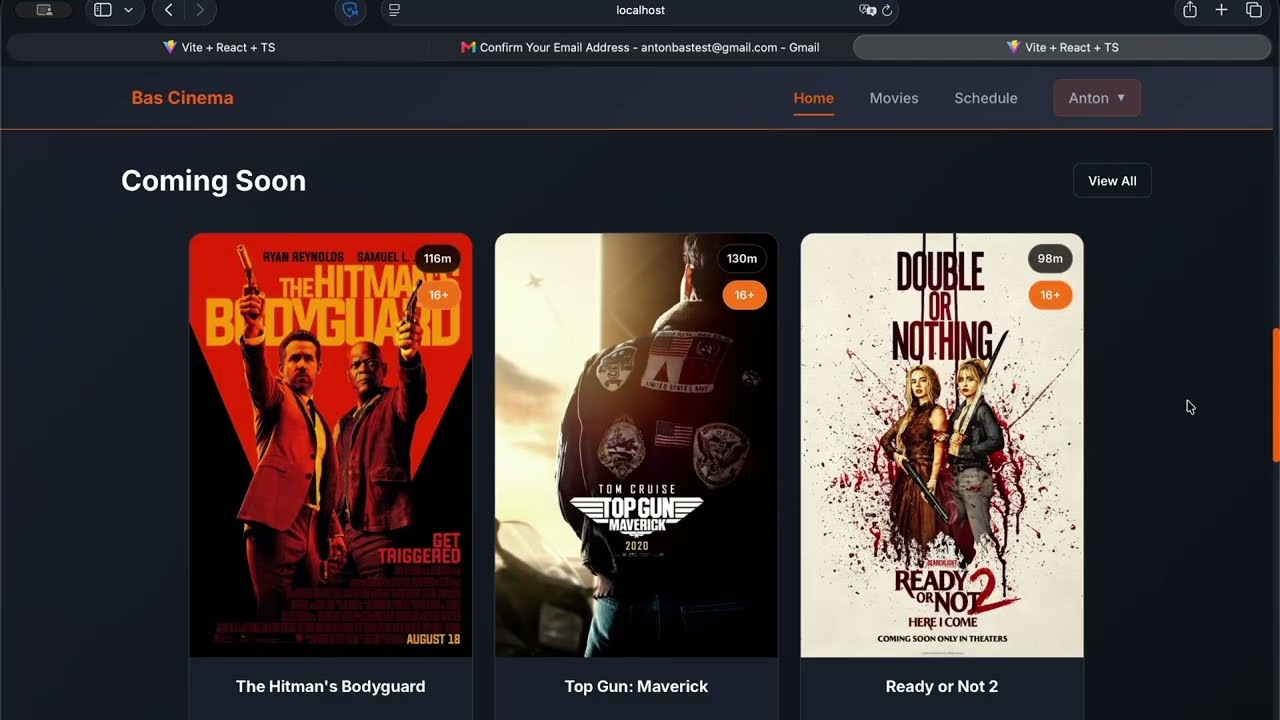

- Registration with email verification, JWT auth, Google OAuth2, password recovery
- Browse Now Showing / Coming Soon / Last Chance movies, custom availability calendar, session search
- Booking: seat selection with live availability, ticket-type pricing, bonus-point redemption, LiqPay payment, QR-coded tickets, confirmation email
- Refunds: time-based refund preview (100% / 85% / 50%) before confirming, automatic bonus rollback and seat release
- Profile management, ticket history (Active / Used / Refunded), bonus balance & transaction history
- Full CRUD for movies, genres, cast, halls (auto-generated seat layouts, interactive editor), schedule (conflict validation), promotions, ticket types
- User management: role changes, birth-date verification, block/unblock
- Configurable bonus rules (welcome, birthday, booking spend, payment accrual)
- Audit log of every admin change, with a per-entity history view
- Cashier: ticket lookup and validation at the door by unique code
Full feature breakdown for every role: docs/DOCS.md#features
Backend — Java 21, Spring Boot 4.1.1, Spring Security, Spring Data JPA, Hibernate 7, PostgreSQL 15, Flyway, Redis 7, JWT + Google OAuth2, MapStruct, Bucket4j (rate limiting), Testcontainers, GitHub Actions CI
Frontend — React 19 + TypeScript, Vite, React Router, Axios, Styled Components
DevOps — Docker / Docker Compose, GitHub Actions
Full version table: docs/DOCS.md#tech-stack
Package by Feature + Layer: each business domain (booking/, payment/, refund/, bonus/, movie/, cinema/, user/, ticket/, promotion/, audit/) is a self-contained package with its own controller/service/repository/domain/dto/mapper, instead of one global layer shared by the whole app. notification/, integration/, and common/ are shared infrastructure packages (mail sending, file/QR/slug handling, stateless utilities) — they never own a business decision, only get called by the domain that does. config/ and exception/ stay global across every domain.
flowchart TD
    A[React Frontend] --> B[Spring Boot API]

    B --> BK["booking/"]
    B --> PM["payment/"]
    B --> RF["refund/"]
    B --> BN["bonus/"]
    B --> MV["movie/ · cinema/ · ticket/ · user/ · ..."]

    BK --> DB[(PostgreSQL)]
    PM --> DB
    RF --> DB
    BN --> DB
    MV --> DB

    PM --> P[LiqPay API]
    P --> CB[Callback Handler]
    CB --> PM
    RF --> P

    S["Schedulers (per domain)"] --> DB
payment/ and refund/ used to live inside the booking package as a single "Payment Service" — they're now their own domains, connected one-way only (refund → payment → booking, never back), which is what keeps the split safe to reason about.
- Two-stage seat locking: 5-min pessimistic hold (
SELECT ... FOR UPDATE) on selection, then a 20-min reservation window before payment.@Versionoptimistic locking everywhere else conflicts are rare. No global locks — only individual seats, only temporarily. - Idempotent payment callbacks: conditional updates (
UPDATE ... WHERE status = 'PENDING') make duplicate LiqPay callbacks safe to ignore;PaymentSchedulerreconciles payments stuck mid-flow. - Refund state machine:
PROCESSING → PROCESSED/REJECTED, with thePROCESSINGrow committed before the gateway call so a crash never loses a refund record;RefundSchedulerreconciles anything still stuck. - Scheduler-based self-healing: one scheduler per domain releases expired locks, cancels unpaid bookings, reconciles stuck refunds/payments, and recovers all of it from PostgreSQL state on restart — no in-memory state to lose.
Full write-up of trade-offs and what was learned building this: docs/DOCS.md
- Concurrency correctness: pessimistic row-level locks prevent double booking under concurrent requests for the same seat; verified with a 10-concurrent-request test where exactly one succeeds.
- Idempotency everywhere it matters: payment callbacks, refund success/failure application, and bonus-point refunds are all safe to retry or receive duplicates without double-processing.
- Financial safety: refund amount/percentage/bonus math has a single source of truth (
RefundCalculator) shared by preview and execution, so they can never disagree; refund execution runs in its own transaction, committed before the external gateway call, so a mid-request crash can't leave a charge with no record. - RBAC across 4 roles (Admin, Content Manager, Cashier, User) enforced at both API and UI level, plus per-endpoint rate limiting against brute-force/abuse.
- 875 tests across 124 test classes, run against real PostgreSQL via Testcontainers (no mocked DB in integration tests)
- Dedicated concurrency test suites per domain:
SeatReservationConcurrencyTest,BookingConcurrencyTest,BookingDoubleConfirmConcurrencyTest,PaymentCallbackConcurrencyTest,RefundCreationConcurrencyTest,BonusCardConcurrencyTest,BonusRefundPointsRetryConcurrencyTest,TicketValidationConcurrencyTest - Failure scenarios verified directly: 10 concurrent bookings for the same seat (exactly 1 wins), 5 duplicate LiqPay callbacks (order reaches
PAIDexactly once), expired reservations auto-released by the scheduler, app killed mid-payment and recovered on restart - Runs on every push/PR to
main/developvia GitHub Actions (.github/workflows/ci.yml)
cd backend && ./mvnw testgit clone https://github.com/AntonBas/Cinema.git
cd Cinema
cp .env.docker.example .env
docker compose up -d| Service | URL |
|---|---|
| Frontend | http://localhost:5173 |
| Backend API | http://localhost:8080/api |
| Swagger | http://localhost:8080/swagger-ui.html |
Local (non-Docker) setup, test accounts, and database reset instructions: docs/DOCS.md#getting-started