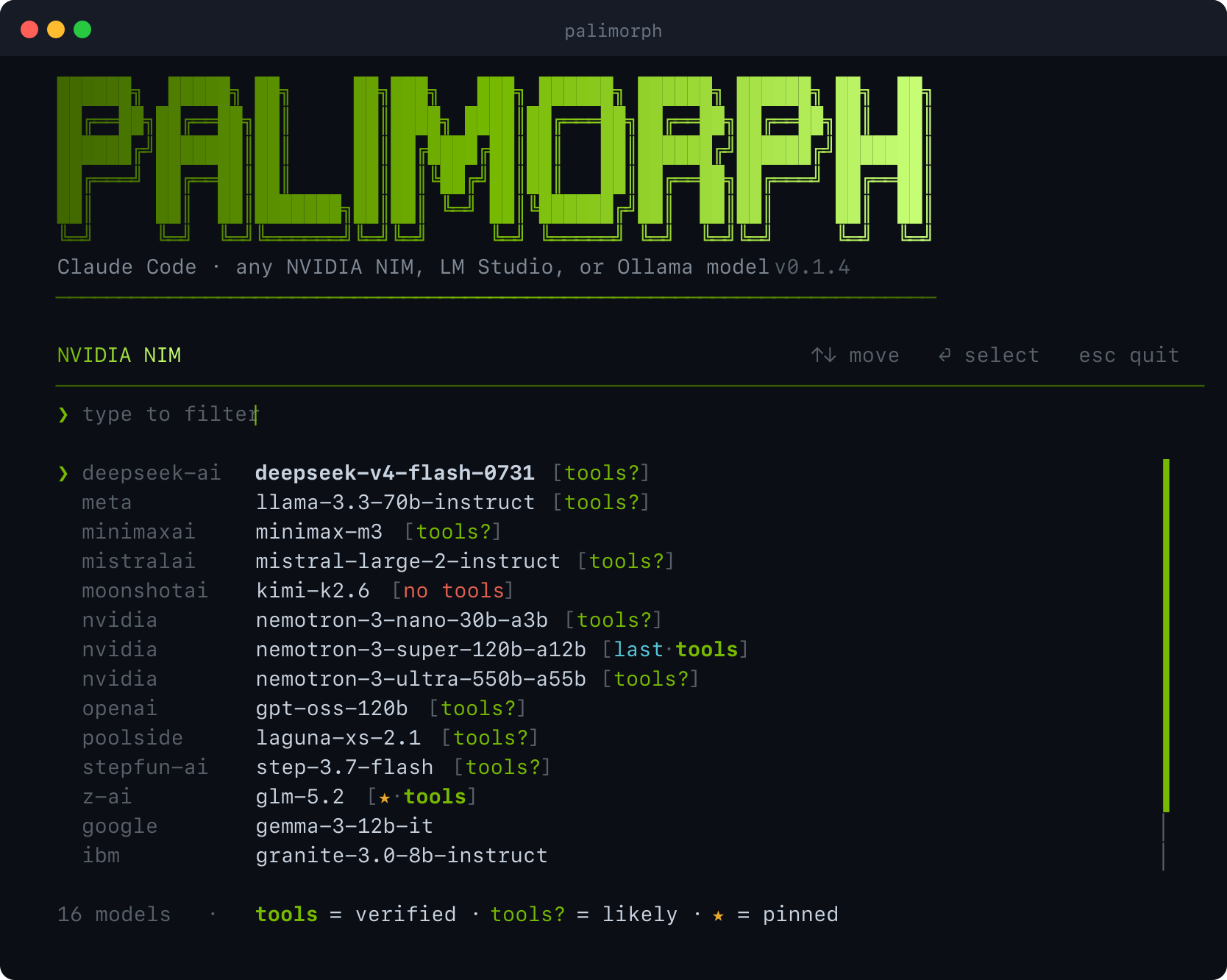


palimorph looks at NVIDIA's NIM catalog and any local LM Studio / Ollama server at
once, lets you pick a model from whatever it finds, and launches Claude Code wired to
it. When that process exits, nothing is left behind — your Claude Code settings files
are never touched.
npx palimorphNIM, LM Studio, and Ollama all expose an OpenAI-compatible API. Claude Code's
ANTHROPIC_BASE_URL only speaks the Anthropic Messages API. Setting environment
variables alone will not connect them — the first request 404s.
So palimorph starts a translation proxy on loopback for the life of the session:
claude ──Anthropic /v1/messages──▶ palimorph proxy ──OpenAI /v1/chat/completions──▶ NIM / LM Studio / Ollama
       ◀──Anthropic SSE events───               ◀──OpenAI delta stream─────────
It translates system prompts, multi-part content, images, tool definitions, tool calls,
tool results, stop reasons, usage, and the full streaming event sequence. The proxy binds
to 127.0.0.1 on an ephemeral port and requires a random per-run token, so nothing else
on the machine can reach it. It dies with the process.
Claude Code itself must be installed:
npm i -g @anthropic-ai/claude-codeThat's it if you already have LM Studio or Ollama
running locally — palimorph looks for both automatically, no key required:
npx palimorphFor NVIDIA NIM, palimorph login does not open a browser — NVIDIA has no OAuth flow
for NIM, so the key is pasted once:
- Sign in at build.nvidia.com (free account).
- Open any model page and use Get API Key.
- Copy the
nvapi-…key.
palimorph login                 # stored at ~/.palimorph/config.json, mode 0600
# or
export NVIDIA_API_KEY=nvapi-…   # env always wins; never written to disk
You don't need to run login up front, either — with no key yet, NVIDIA still shows up
in the picker below, and selecting it prompts for the key right there.
With no --provider flag, palimorph checks NVIDIA NIM (if a key is already known), LM
Studio (127.0.0.1:1234), and Ollama (127.0.0.1:11434) at once, and shows everything it
finds in a single picker — vendor column tells them apart. Nothing running locally and no
NVIDIA key yet? You still get one entry to paste a key and go.
palimorph                        # look at everything, pick, launch
palimorph --provider lmstudio    # skip discovery, go straight to LM Studio
palimorph --provider ollama      # skip discovery, go straight to Ollama
palimorph --provider custom --base-url http://host:port/v1   # any other OpenAI-compatible server
Whichever model you pick, the provider and base URL are remembered as your last pick — a
plain palimorph --last reuses it without scanning again.
palimorph                              # pick a model, launch Claude Code
palimorph --last                       # reuse your last pick
palimorph qwen/qwen3-coder-480b-a35b-instruct
palimorph --tools-only                 # only models known to do tool calling
palimorph models                       # print the catalog (plain stdout, pipe-safe)
palimorph status                       # key, endpoint, connectivity, last model
palimorph check z-ai/glm-5.2           # ask a model to make a real tool call
palimorph fav moonshotai/kimi-k2-instruct   # pin to the top of the picker
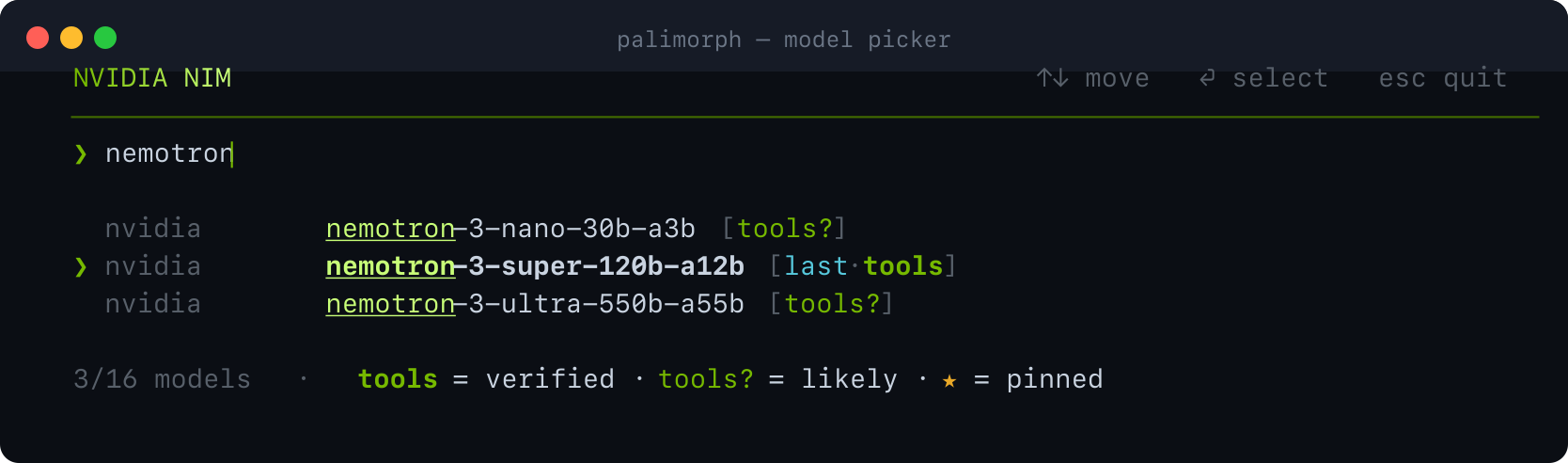
palimorph -- -p "summarize this repo" # everything after -- goes to claudeStart typing to narrow the catalog; matches are underlined as you type.
↑↓ to move, ⏎ to select, esc to quit.
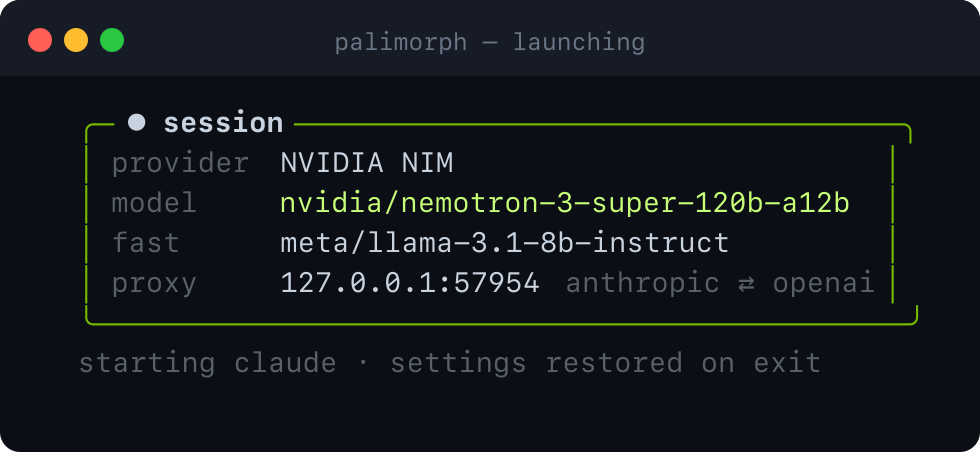
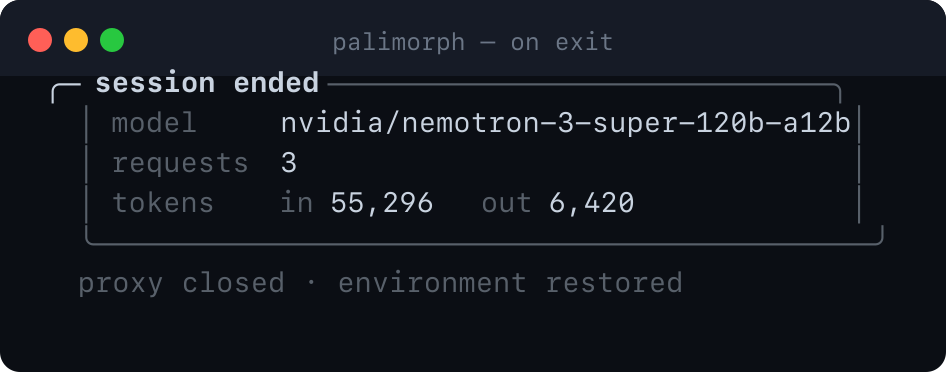
Claude Code runs normally from here. On exit you get the tally, and the proxy is gone:
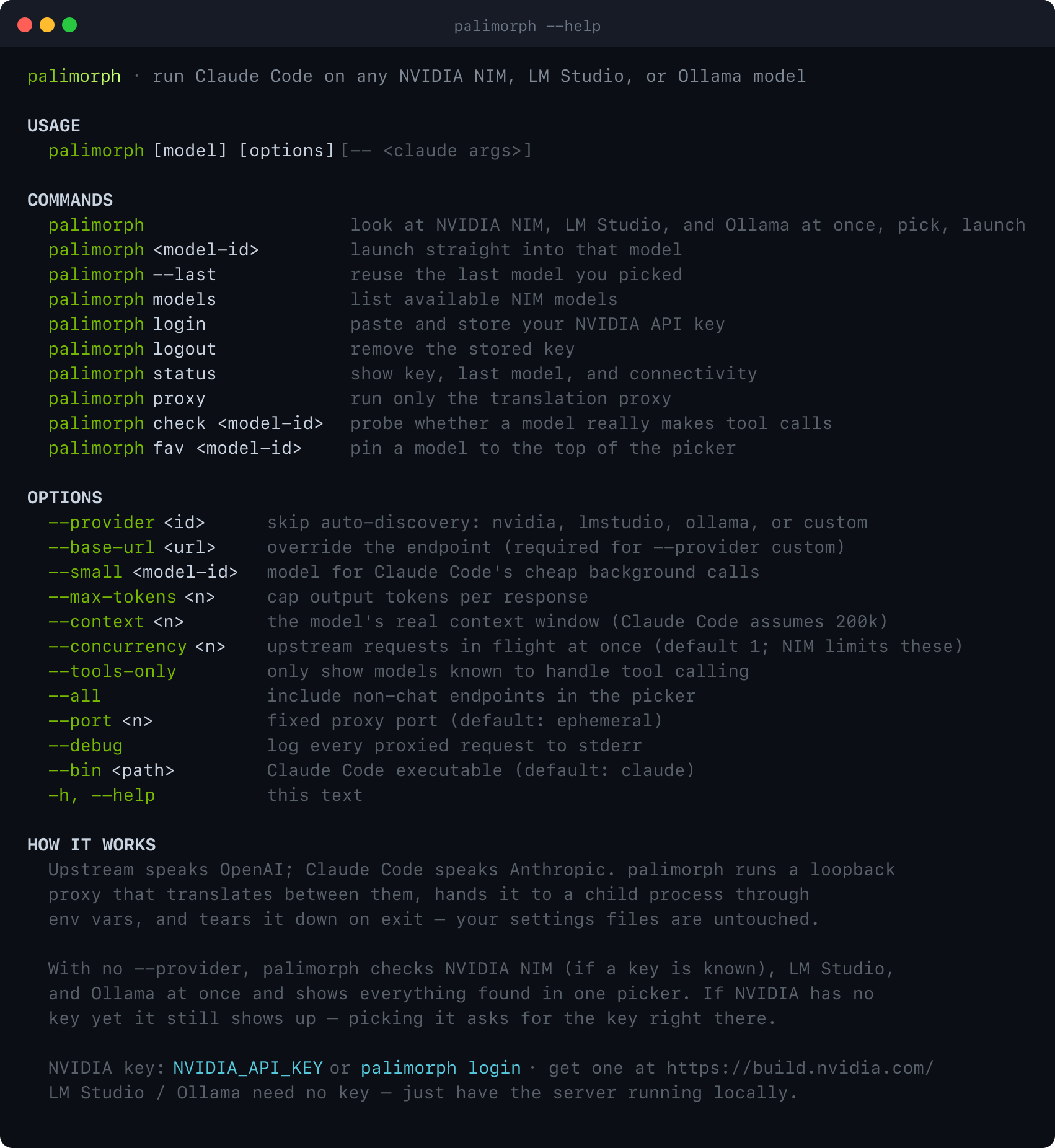
| Flag | Meaning |
|---|---|
--provider <id> |
skip auto-discovery: nvidia, lmstudio, ollama, or custom |
--base-url <url> |
override the endpoint (required for --provider custom) |
--small <id> |
model for Claude Code's cheap background calls (titles, summaries) |
--max-tokens <n> |
cap output tokens per response |
--context <n> |
the model's real context window (Claude Code otherwise assumes 200k) |
--concurrency <n> |
upstream requests in flight at once (default 1 — NIM limits these) |
--tools-only |
only list models known to handle tool calling |
--all |
include non-chat endpoints (embedding, rerank, vision) in the picker |
--port <n> |
fixed proxy port instead of an ephemeral one |
--debug |
log every proxied request to stderr |
--bin <path> |
Claude Code executable (default claude) |
--no-banner |
skip the hero banner |
palimorph --help
To point an existing tool at NIM without spawning anything:
eval "$(palimorph proxy meta/llama-3.3-70b-instruct)"Claude Code is an agentic tool: it is useless with a model that will not emit tool
calls. Family names do not prove support and NIM's catalog reports no capabilities, so
palimorph asks the model directly — one tiny tool call, the first time you use it:
$ palimorph check nvidia/nemotron-3-super-120b-a12b
✔ nvidia/nemotron-3-super-120b-a12b makes tool calls — usable with Claude Code

$ palimorph check moonshotai/kimi-k2.6
▲ moonshotai/kimi-k2.6 did not make a tool call: listed in the catalog but not
  enabled for this account
Verdicts are cached in ~/.palimorph/config.json, so the picker shows what is real:
| Badge | Meaning |
|---|---|
tools |
probed and confirmed to make tool calls |
tools? |
family suggests it should — not probed yet |
no tools |
reachable, but answered in prose instead of calling the tool |
unavailable |
listed in the catalog, but your account cannot invoke it |
--tools-only filters on the cached verdicts, falling back to the family guess for
models you have not probed. Models that stream a <think> scratchpad have it stripped
before it reaches Claude Code.
Tool-call reliability still varies between models that pass the probe — one that makes a clean call once can still lose the thread on a long agentic session. Try a few.
Eight models were measured on a real Claude Code loop (run the tests, read the failure, fix the source, re-run): six solved it, and the cost between them varied by more than 2×. See docs/nim-agent-benchmark.md.
The banner, picker, and cards adapt rather than break:
| Condition | Behaviour |
|---|---|
NO_COLOR / not a TTY / TERM=dumb |
all colour dropped |
| 256-colour or 16-colour terminal | gradients quantised to the nearest palette |
| terminal narrower than 55 columns | hero collapses to a one-line wordmark |
PALIMORPH_ASCII=1 or plain Windows console |
box-drawing swapped for ASCII |
PALIMORPH_NO_BANNER / --no-banner |
banner suppressed entirely |
Everything decorative goes to stderr, so palimorph models | grep coder and
palimorph --version stay clean.
- Prompt caching, extended thinking blocks, and the web-search / computer-use server tools are Anthropic-side features with no NIM equivalent; they are dropped, not faked.
count_tokensreturns a character-based estimate — NIM has no token counting endpoint.- On NIM, rate limits are per model, per account, and on the free tier some models
are far tighter than others — one model can be exhausted while another answers
instantly.
palimorphsends at most one upstream request at a time by default (Claude Code otherwise fires background calls alongside the main query, which is enough to trip a limit — or overload a local model — on its own) and retries429s with backoff, honouringRetry-After. A quota that is genuinely spent still surfaces — raise throughput with--concurrencyonly if your account (or local machine) can take it, and use--smallso background calls do not spend the main model's quota. - NIM's catalog over-reports.
/v1/modelslists models your account cannot invoke, and the records are byte-identical to working ones —{id, object, created, owned_by}, nothing that marks availability. There is no way to filter them out in advance; the only signal is a real call, which is whatpalimorph checkmakes. The model list itself is NVIDIA's own/v1/modelsverbatim, minus embedding/rerank/guard endpoints (--allkeeps those). LM Studio and Ollama only list what is actually loaded or pulled, so this does not apply to--provider lmstudio/ollama— but the model still may not support tool calling, which is whatpalimorph checkverifies either way. - A cold model can take minutes to emit its first token — a NIM model spinning up, or a
local model loading into memory for the first time.
palimorphopens the response stream as soon as the upstream accepts the request and sends keep-alive pings, so the client does not time out waiting for headers. - Claude Code prints a notice that claude.ai connectors are disabled whenever an auth source is set. That is unavoidable — pointing it at a different provider is setting one.
- With the NVIDIA provider, your prompts and code go to NVIDIA's servers, under NVIDIA's
terms — not Anthropic's. With
--provider lmstudio/ollama, nothing leaves your machine — the model runs locally and the proxy only talks tolocalhost.
npm test                      # proxy, error mapping, and a full spawn round trip
node tools/screenshots.mjs    # regenerate docs/media from the real CLI output
The suite runs against a fake NIM upstream on loopback — no API key, no network. CI runs it on Linux, macOS and Windows across Node 18.17 – 24, and separately packs the tarball and installs it as a consumer would.
The screenshots are captured from the actual ui/picker/run code paths with a faked
TTY, then rendered to SVG — so they cannot drift away from what the CLI prints.
MIT © Ahmet Atar