


⚡ CRITICAL DOCKER PORT MAPPING REQUIREMENT (
5001:5001):
To access TRIAD's Web Dashboard, you MUST configure port mapping5001:5001:
• Command Line (CLI): Rundocker run -d -p 5001:5001 lsbnb/triad:latest
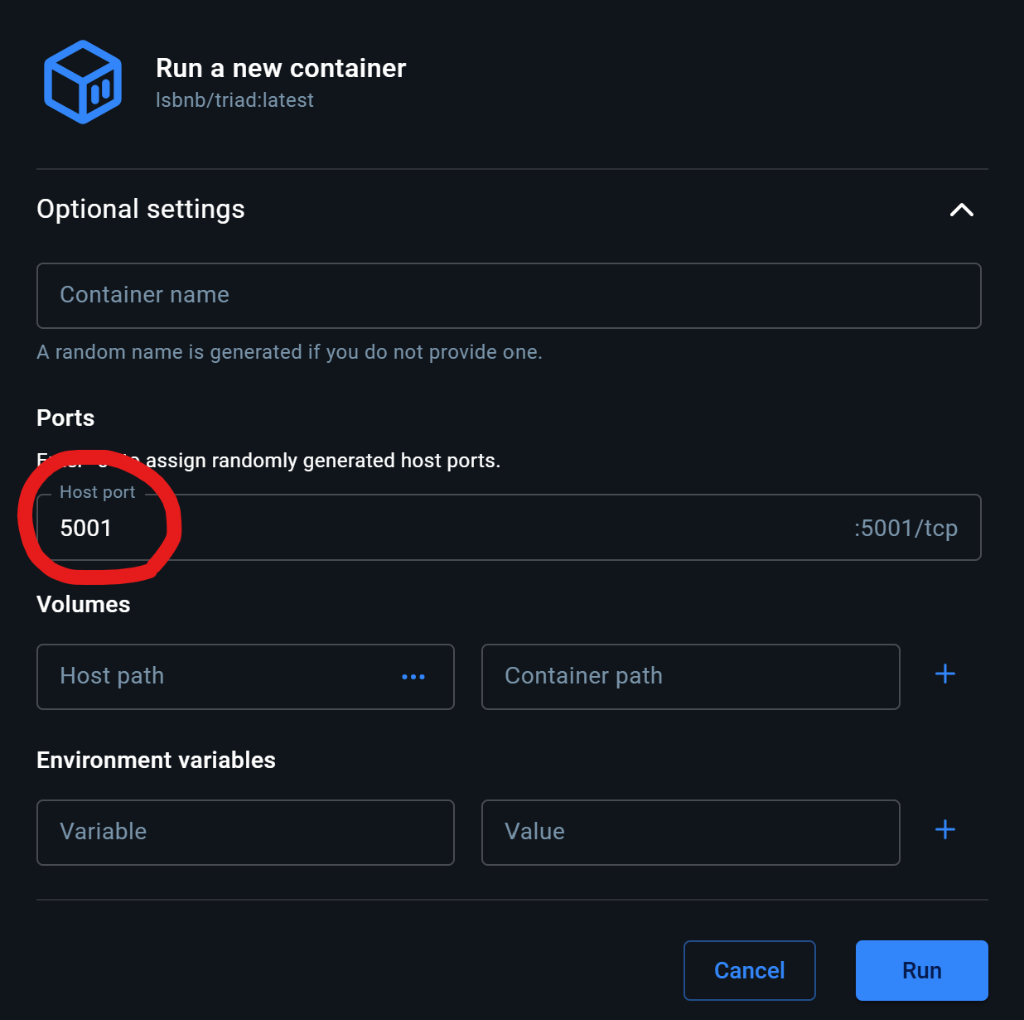
• Docker Desktop GUI: Expand Optional settings → Ports and set Host port:5001(mapping to:5001/tcp).
Without setting Host Port 5001,http://localhost:5001will fail to load!
TRIAD (Multimodal T-Cell Epitope Prioritization and Autonomous Immunology AI Agent Platform) is an integrated, high-performance web platform designed for rapid CD8+ T-cell epitope discovery, antigen presentation prediction, physicochemical T-cell immunogenicity scoring, and global population coverage analysis.
Developed by the Laboratory of Systems Biology and Bioinformatics (LSBNB), Institute of Information Science, Academia Sinica, Taiwan.
- High-Throughput Epitope Discovery: Supports raw peptide lists or full-length protein FASTA sequences with configurable k-mer sliding windows (8–14 aa).
- MHC-I Antigen Presentation ANN: Integrates NetMHCpan-4.2 trained on over 1,000,000 mass spectrometry eluted ligands (MS-EL) and quantitative binding affinity (BA) datasets.
- Physicochemical T-Cell Immunogenicity: Implements Calis et al. (2013) log-odds scoring model based on position-weighted amino acid properties at TCR-contact positions (positions 4–8).
- Physicochemical TCR Contact Feature Evaluation: Evaluates T-cell receptor contact amino acid properties to predict immune activation potential and candidate concordance.
- Population-Aware Coverage: Computes non-redundant population coverage across global and regional cohorts (Taiwan, East Asia, Europe, World).
- Multimodal Candidate Tiering: Automatically categorizes candidates into Tier 1 (High priority), Tier 2 (Secondary), and Tier 3 based on a harmonized 4-dimensional Composite Priority Index.
- In-Memory RAM Disk Acceleration Engine: Parallel multi-core batch processing using
/dev/shmfor zero-disk-latency temporary sequence ingestion.
docker pull lsbnb/triad:latest
# or
docker pull lsbnb/mhcpan_shell:latestRun the container mapping host port 5001 to container port 5001:
docker run -d \
  --name triad_app \
  -p 5001:5001 \
  --restart unless-stopped \
  lsbnb/triad:latest
Open your browser and navigate to:
👉 http://localhost:5001 (or http://127.0.0.1:5001)
If you use Docker Desktop GUI:
- Click Run on the
lsbnb/triad:latestimage. - Expand Optional settings → Ports.
- Fill in
5001in the Host port field (which maps to:5001/tcp). - Click Run.
⚠️ IMPORTANT: Leaving Host port empty causes Docker Desktop to assign a random host port, makinghttp://localhost:5001inaccessible.
netMHCpan-4.2 is academic-licensed software copyrighted by DTU Health Tech (Technical University of Denmark). Its academic license explicitly prohibits third-party redistribution of binary executables and model parameters ("not give the program to third parties").
For legal compliance, the public Docker image (lsbnb/triad) ships as a clean application shell without pre-bundled DTU files. Each user must obtain their own copy directly from DTU.
- Visit the Official DTU Download Portal.
- Request the Linux tarball package (filename format:
netMHCpan-4.2.Linux.tar.gz).
Extract the package on your host machine and mount it to /opt/netMHCpan-4.2:
# 1. Unpack DTU package on host
tar -xzvf netMHCpan-4.2.Linux.tar.gz

# 2. Start container with volume mount and port mapping 5001:5001
docker run -d \
  --name triad_app \
  -p 5001:5001 \
  -v /dev/shm:/dev/shm \
  -v "$(pwd)/netMHCpan-4.2:/opt/netMHCpan-4.2" \
lsbnb/triad:latest- Start the container with port mapping
5001:5001:docker run -d --name triad_app -p 5001:5001 lsbnb/triad:latest
- Open
http://localhost:5001/setupin your web browser. - Upload your
netMHCpan-4.2.Linux.tar.gzfile. - Confirm license compliance and click Upload & Install. The platform automatically extracts, verifies, tests, and activates the engine.
Create a docker-compose.yml file:
version: '3.8'

services:
  triad:
    image: lsbnb/triad:latest
    container_name: triad_app
    ports:
      - "5001:5001"
    volumes:
      - /dev/shm:/dev/shm
      - ./netMHCpan-4.2:/opt/netMHCpan-4.2
    restart: unless-stopped
Run with:
docker compose up -dOutput tables and exported CSV / Excel reports strictly follow standard NetMHCpan ordering with Protein ID / Identifier positioned in the first column:
| Col # | Field | Label | Description |
|---|---|---|---|
| 1 | Identity |
Protein ID / Identifier | FASTA header sequence ID or source protein identifier (e.g. sp|P0DTC2|SPIKE_SARS2 or PEPLIST). |
| 2 | Pos |
Position | Amino acid starting position in the source protein. |
| 3 | MHC |
HLA Allele | Targeted HLA allele (e.g., HLA-A*02:01). |
| 4 | Peptide |
Peptide Sequence | Predicted k-mer peptide amino acid sequence. |
| 5 | Core |
Core Motif | Binding core motif predicted by NetMHCpan. |
| 6 | Score_EL |
Presentation Score | Raw eluted ligand presentation probability (0.0000 ~ 1.0000). |
| 7 | Rank_EL |
%Rank EL | Presentation percentile rank ( |
| 8 | Affinity_nM |
Binding IC50 (nM) | Quantitative IC50 binding affinity in nanomolar ( |
| 9 | Immunogenicity_Score |
T-Cell Immunogenicity | Calis et al. physicochemical TCR contact activation score ( |
| 10 | Composite_Score |
Composite Priority Index | 4-Dimensional harmonized priority index (0.0000 ~ 1.0000). |
| 11 | Tier |
Decision Priority Tier | Tier 1 (High priority), Tier 2 (Secondary), Tier 3 (Low priority). |
| 12 | BindLevel |
Binder Category |
SB (Strong Binder), WB (Weak Binder), or empty. |
curl -s http://localhost:5001/api/system_resources | jq .curl -s -X POST http://localhost:5001/api/predict \
-H "Content-Type: application/json" \
-d '{
"mode": "peptide",
"input": "AAAWYLWEV\nAEFGPWQTV\nYLLPAIVHI\nGILGFVFTL",
"alleles": ["HLA-A*02:01", "HLA-B*07:02"],
"include_ba": true
}'curl -O http://localhost:5001/api/download/<JOB_ID>/csv- NetMHCpan Presentation Model:
Reynisson B, et al. NetMHCpan-4.1 and NetMHCIIpan-4.0: improved predictions of MHC antigen presentation. Nucleic Acids Res. 2020;48(W1):W449-W454. doi:10.1093/nar/gkaa379 - T-Cell Immunogenicity Model:
Calis JJ, et al. Properties of MHC Class I Presented Peptides That Inspire Immunogenicity. PLoS Comput Biol. 2013;9(10):e1003266. doi:10.1371/journal.pcbi.1003266 - Population Coverage Database:
Gonzalez-Galarza FF, et al. Allele frequency net database (AFND) 2020 update. Nucleic Acids Res. 2020;48(D1):D783-D788. doi:10.1093/nar/gkz1029
Laboratory of Systems Biology and Bioinformatics (LSBNB)
Institute of Information Science, Academia Sinica, Taipei, TAIWAN.
Web: https://hub.docker.com/r/lsbnb/triad