feat(sts): GetCallerIdentity + real configure-aws-credentials integration test - #126
Merged
Merged
Conversation


|
Claude finished @alukach's task in 18s —— View job ✅ No blocking issues — safe to merge. I read the diff and traced Non-blocking observations
Simplify (ponytail)
💰 Estimated review cost: $0.16 · 0m18s · 6 turns |
 alukach
changed the title
alukach
changed the title

|
📖 Docs preview deployed to https://multistore-docs-pr-126.development-seed.workers.dev
|
|
🚀 Latest commit deployed to https://multistore-proxy-pr-126.development-seed.workers.dev
|
alukach
marked this pull request as ready for review
July 27, 2026 19:40
alukach
added a commit
to source-cooperative/data.source.coop
that referenced
this pull request
Aug 26, 2026

Out of scope for ADR-004, which specifies the exchange rather than the
compatibility of any one client. The gap is already tracked in #184 and
developmentseed/multistore#126.

Co-Authored-By: Claude Opus 5 <noreply@anthropic.com>
Claude-Session: https://claude.ai/code/session_01HGZ598AJ1F7NWoyPpgepBt
alukach
added a commit
to source-cooperative/data.source.coop
that referenced
this pull request
Sep 23, 2026
The action requires the aws partition and validates with GetCallerIdentity (developmentseed/multistore#126).

Co-Authored-By: Claude Fable 5.1 <noreply@anthropic.com>
Claude-Session: https://claude.ai/code/session_01REZWKgQy2PDETn6j9YpM4z
alukach
added a commit
to source-cooperative/source.coop
that referenced
this pull request
Sep 24, 2026
Closes #547. Part of #491. Stacked on #566, now merged, so the diff is this branch alone: the feature commit, the immutable-subject commit, two review-fix commits, a redesign of the form and the list, a fix for writing trusts, owner-namespaced ids, and an account page that is where creating lands and where grants are edited, with the create form's product list, showing what it reaches and granting more from a new row. ## What The real version of the flow #495 mocked, built on the model (#563), the membership pages (#564) and account trusts (#566). Rebuilt on the trust model in one commit; what review changed follows as commits of its own. **Settings → Service Accounts** appears for individuals and organizations alike, to whoever `canManageAccount` says manages the account. The list page loads each service account with its trusts, its grants and (from #570) its keys. **`ServiceAccountForm`** — who it is (the name, and the id derived from it, shown as code with an Edit link the way the data-connection form shows its id), how software signs in (any number of GitHub workflows, each a card with the repository on its own row — `owner/repo`, or `owner@id/repo@id` for the immutable subjects GitHub mints for repositories created after July 2026 or opted in — then a Ref/Environment segmented control and its value, and the exact subject shown as you type), what it may reach (the products it reaches, each with Read / Read and write and a red X, and **Grant a product**, which adds a row with a dropdown of the owner's other products (each option the product's name over its `owner/product` path in small monospace), a Read / Read and write choice, and a green check that finalizes it, beside an X that cancels — the same `ProductAccessList` on the create form and the account's page; each title opens the product in a new tab, and the form holds its grants until it is submitted). **The id is namespaced under the owner:** `{owner}--{id}`, such as `acme--nightly-sync`, joined by the `--` account-owned data connections already use. Two owners can each have a `nightly-sync`, a service account never takes a handle a person or organization might want (their ids cannot contain `--`), and no service-account id can equal an Ory identity id, which is a UUID. The form asks for the short id and shows the whole one; the action composes it. `ServiceAccountSchema` requires the composed form, and a membership's member id accepts it, which granting a namespaced service account a product needs. The general `createAccount` action no longer takes `type=service`: nothing posted it, and it created service accounts without the owner checks or the namespace. Submitting writes the account, its grants and its trusts, and redirects to the account's page, where each trusted workflow's example usage is a click away. Nothing has to run first, and the step carries nothing that expires. **`ServiceAccountList`** — one row per account in the data connections' own `ConnectionList`/`ConnectionRow`: the name linking to the account's page, its id, a marker when it is disabled, and how many workflows it trusts and products it reaches. **`ServiceAccountDetail`**, at `/edit/account/{owner}/service-accounts/{id}` — the account's page: the workflows it trusts as rows, each removed with a red X (captioned "Remove" on hover, labelled with the subject for screen readers), each with an **Example usage** link that opens the step the workflow adds in a modal, and the "Trust a GitHub workflow" dialog on the section header, which writes the trust and closes onto the new row; the products it reaches, each with Read / Read and write and a red X, and **Grant a product**, which adds a row with a dropdown of the owner's other products (each option the product's name over its `owner/product` path in small monospace), a Read / Read and write choice, and a green check that finalizes it, beside an X that cancels — the same `ProductAccessList` on the create form and the account's page, here **saved as each is made** (the check, a change of access, or an X), shown at once (`useOptimistic`) with the controls held while it saves; each title opens the product in a new tab so a viewer can check what it holds; and Disable and Delete set apart in a danger zone. The page resolves the account through `managedServiceAccount` and 404s unless it is under its own owner. The actions revalidate the list and the page. Delete confirms in an alert dialog whose submit runs the action (a plain button, not `AlertDialog.Action`, which would close the dialog before the action ran) and shows the action's message if it refuses; deleting removes the grants and the account with its trusts, then redirects to the list. The trust dialog's form lives inside `Dialog.Content`, so each open starts fresh. The page passes the data-proxy origin down for the example; without one, no example is offered. **The workflow snippet** (`src/lib/services/github-workflow.ts`) is the `aws-actions/configure-aws-credentials@v6` step pointed at the data proxy — `sts-endpoint`, `audience` = the proxy origin — naming the account in `role-to-assume: arn:aws:iam::<service-account-id>:role/FullAccess`, plus `env` pointing S3 clients at the proxy. From then on any S3 client in the job works, if the account trusts the workflow's subject. **Depends on developmentseed/multistore#126:** the action validates the credentials it exports with `GetCallerIdentity`, which the proxy answers once that lands. **`AccountInfoHoverCard`**, the card an account name opens on hover anywhere in the app, marks a service account with the outlined "Service account" badge the picker and memberships table already use. **What this PR adds to the model:** `canManageServiceAccount(session, account, owner)` — whoever manages the owner manages the service account, answered through `canManageAccount` on the fetched owner, so an admin is included, a disabled owner takes its service accounts out of reach with it (admins aside), and nothing that is not a service account qualifies; a disabled service account is still managed so it can be re-enabled or deleted. `managedServiceAccount(session, id)` in `src/lib/accounts/service-accounts.ts` is the one resolver the lifecycle actions (and, in #570, the key actions) go through: it loads the account and its owner and answers null for anything not managed. And `AccountTrustsTable.create` (schema-validated, conditional, `AlreadyTrustedError`) and `delete`, which were in #566 until review noted nothing there called them. **Server actions** (`src/lib/actions/service-accounts.ts`): `createServiceAccount`, `addGithubTrust`, `removeTrust`, `setServiceAccountDisabled`, `deleteServiceAccount`, and for grants `setProductAccess`. Create loads the owner and requires an enabled individual or organization the caller manages — settled before any of its products are read, so the form can't be used to probe another account's catalogue — deduplicates the workflows and grants it was posted. The rest go through `managedServiceAccount`; `setProductAccess` also applies `serviceAccountGrantProblem` (read or write, the owner's products only), changes the grant the account already has rather than adding a second, touches only the account's own grants, and on none revokes by setting the membership Revoked, as a person's is. No action builds a workflow step: the page does, from the proxy origin. A disabled account takes no new trust, and a repeat is named for what it is. `removeTrust` deletes by the account's own key, so it can never touch another account's. ## Stories On this branch's deploy: - `ServiceAccountForm` › **Default** — https://source-coop-ui-git-feat-service-account-management-radiantearth.vercel.app/?path=/story/features-service-accounts-serviceaccountform--default (submitting redirects in the app; Storybook cannot follow that, so the mocked action just resolves) - `ServiceAccountForm` › **NoProducts** — https://source-coop-ui-git-feat-service-account-management-radiantearth.vercel.app/?path=/story/features-service-accounts-serviceaccountform--no-products - `ServiceAccountList` › **Default**, **Disabled**, **Empty** — https://source-coop-ui-git-feat-service-account-management-radiantearth.vercel.app/?path=/story/features-service-accounts-serviceaccountlist--default - `AccountInfoHoverCard` › **ServiceAccount** — https://source-coop-ui-git-feat-service-account-management-radiantearth.vercel.app/?path=/story/components-accounts-accountinfohovercard--service-account (hover the name) - `ProductAccessList` › **NothingGranted**, **SomeGranted**, **EverythingGranted**, **Saving**, **NoProducts** — https://source-coop-ui-git-feat-service-account-management-radiantearth.vercel.app/?path=/story/features-service-accounts-productaccesslist--some-granted (controlled, so every control works, Grant a product included) - `ServiceAccountDetail` › **Default**, **Disabled**, **Empty** — https://source-coop-ui-git-feat-service-account-management-radiantearth.vercel.app/?path=/story/features-service-accounts-serviceaccountdetail--default ("Example usage" opens the step in a modal; "Grant a product" adds the row to choose a product and its access; an access change shows while the mocked save runs, then springs back, since the mock saves nothing) - `WorkflowSnippet` › **Default**, **ImmutableSubject** — https://source-coop-ui-git-feat-service-account-management-radiantearth.vercel.app/?path=/story/features-service-accounts-workflowsnippet--default - `GithubWorkflowFields` › **Empty**, **ImmutableRepositoryWithRemove** — https://source-coop-ui-git-feat-service-account-management-radiantearth.vercel.app/?path=/story/features-service-accounts-githubworkflowfields--empty (controlled, so the stories hold the workflow in state and the fields can be typed into) The form, the detail and the dialog use `useActionState`, so they are on the smoke test's cannot-render-under-jest list alongside the other action-state forms; `WorkflowSnippet`, `GithubWorkflowFields` and `ProductAccessList` render there. The stories and the Storybook mock build the step with `githubWorkflowStep` rather than carrying a copy of it. ## Screenshots The create form: the id derived from the name, one workflow card, and each product's access chosen in place: 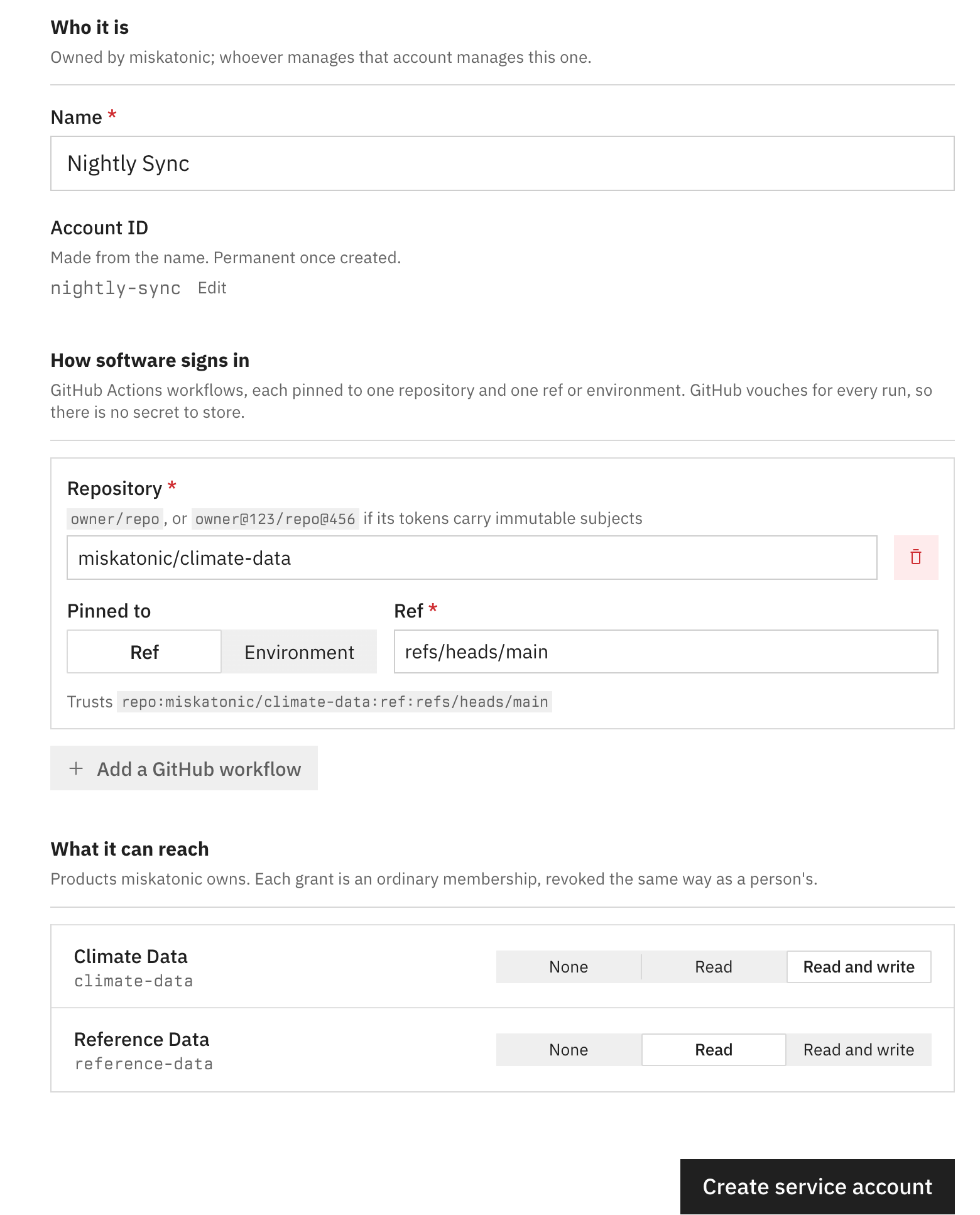 The list, one row per account: 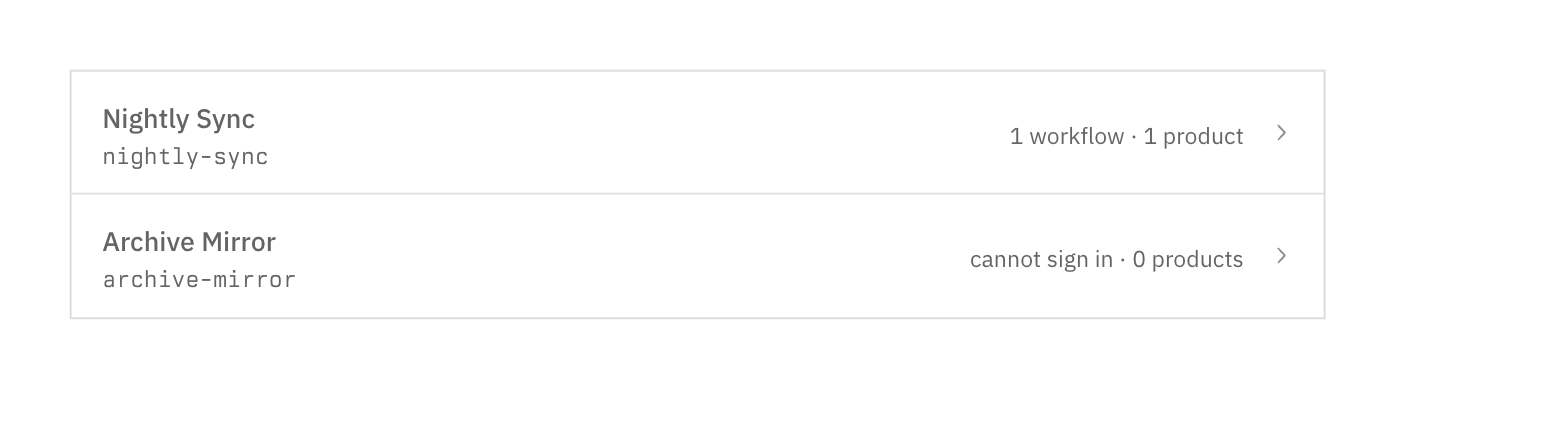 The id, derived from the name under the owner, and the same id opened for editing: 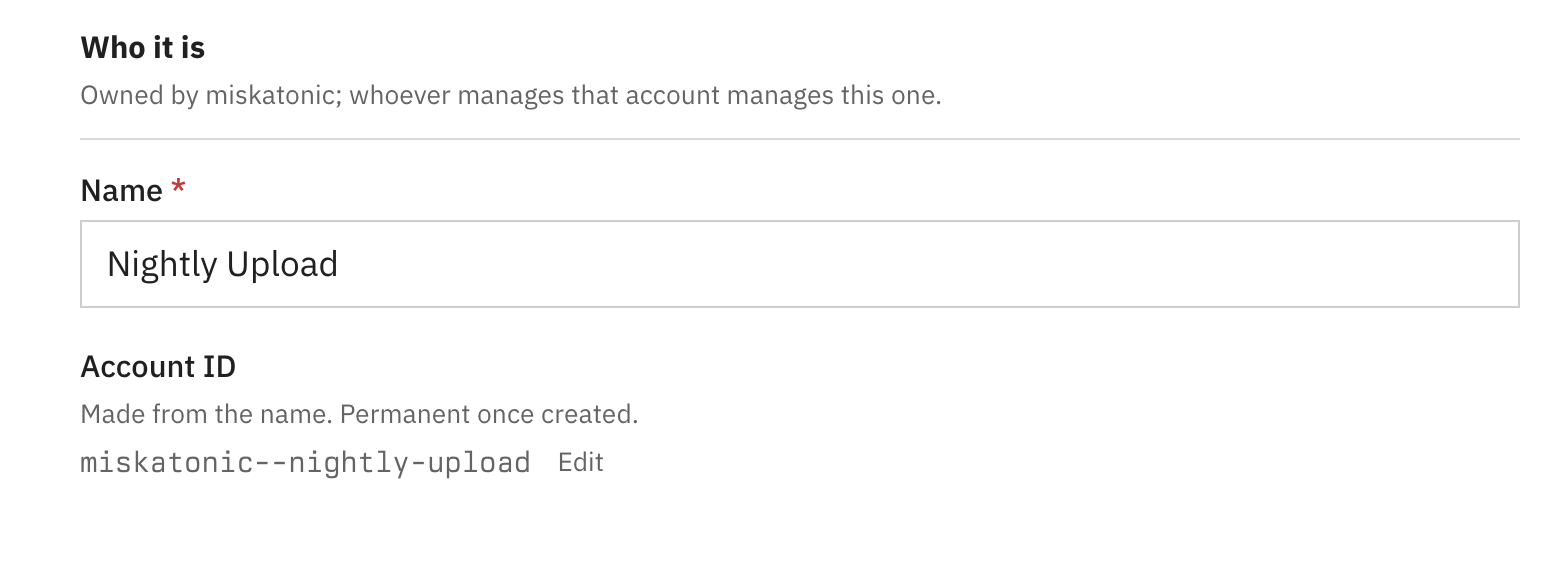 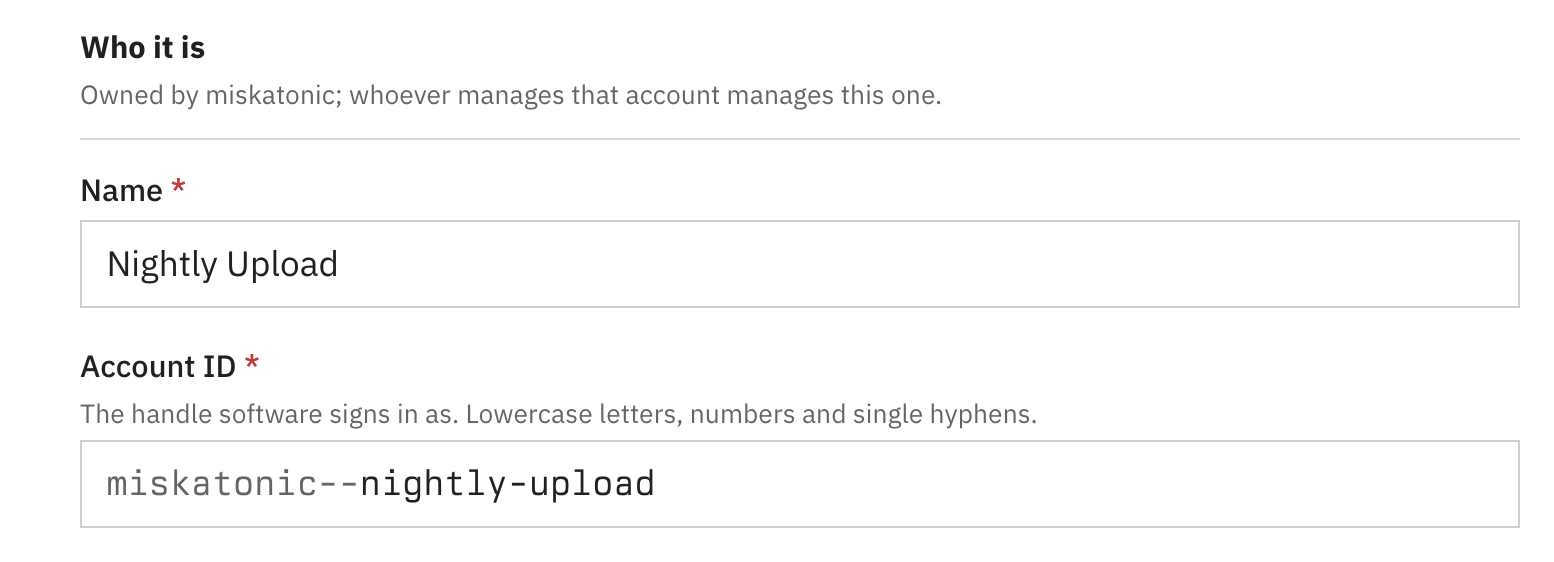 An account's page, where creating one lands. Each trusted workflow has Example usage; the products it reaches are listed with their access and an X, with Grant a product below: 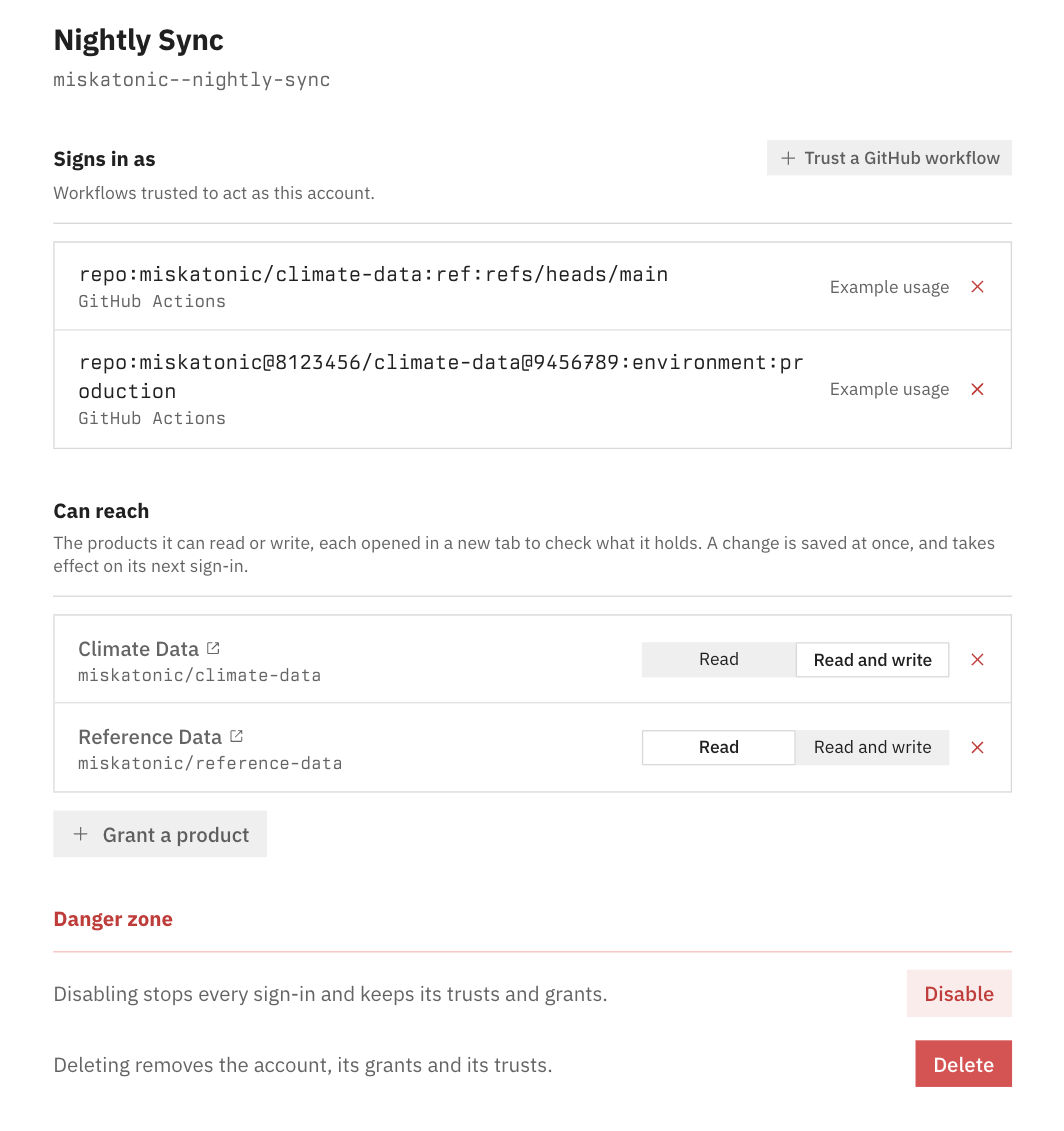 After Grant a product: a row to choose the product and its access, finalized with the check: 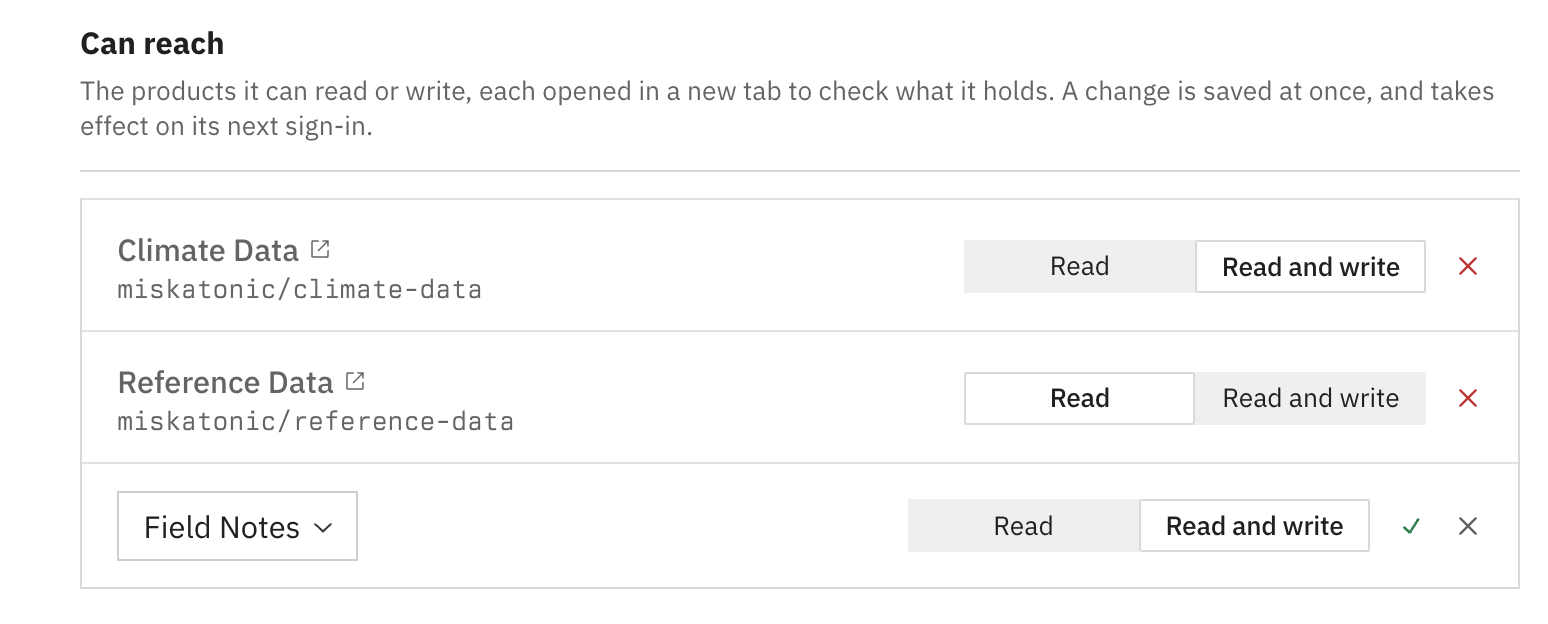 A trust row, with the Remove caption showing on the X: 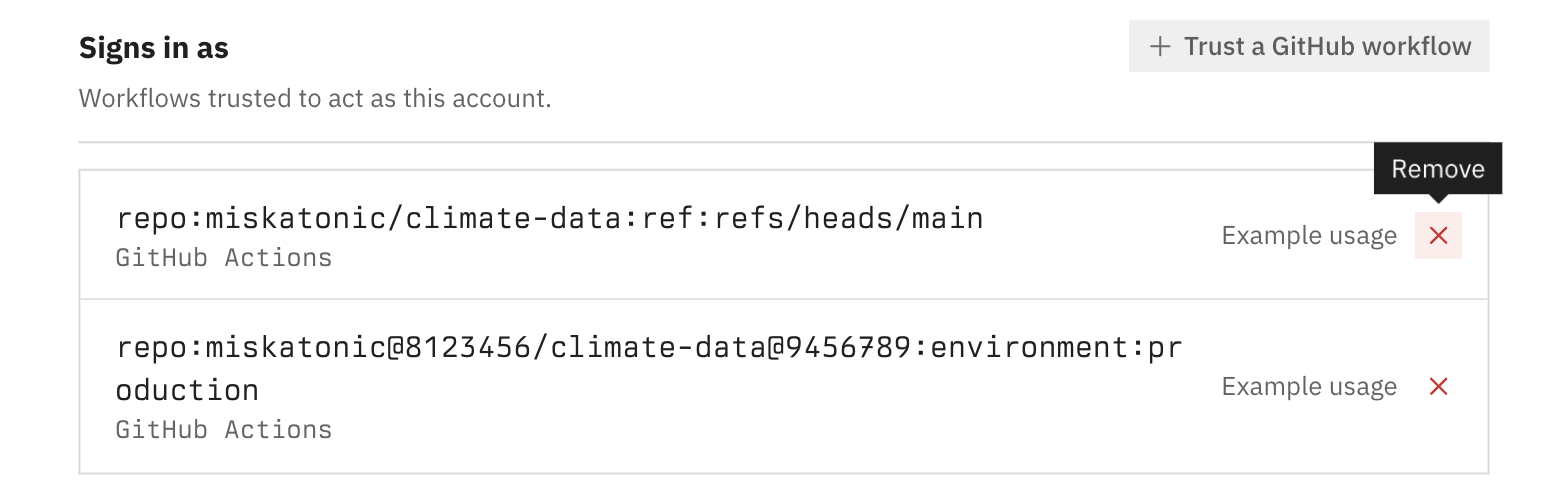 The grant row's dropdown, each product's name over its path: 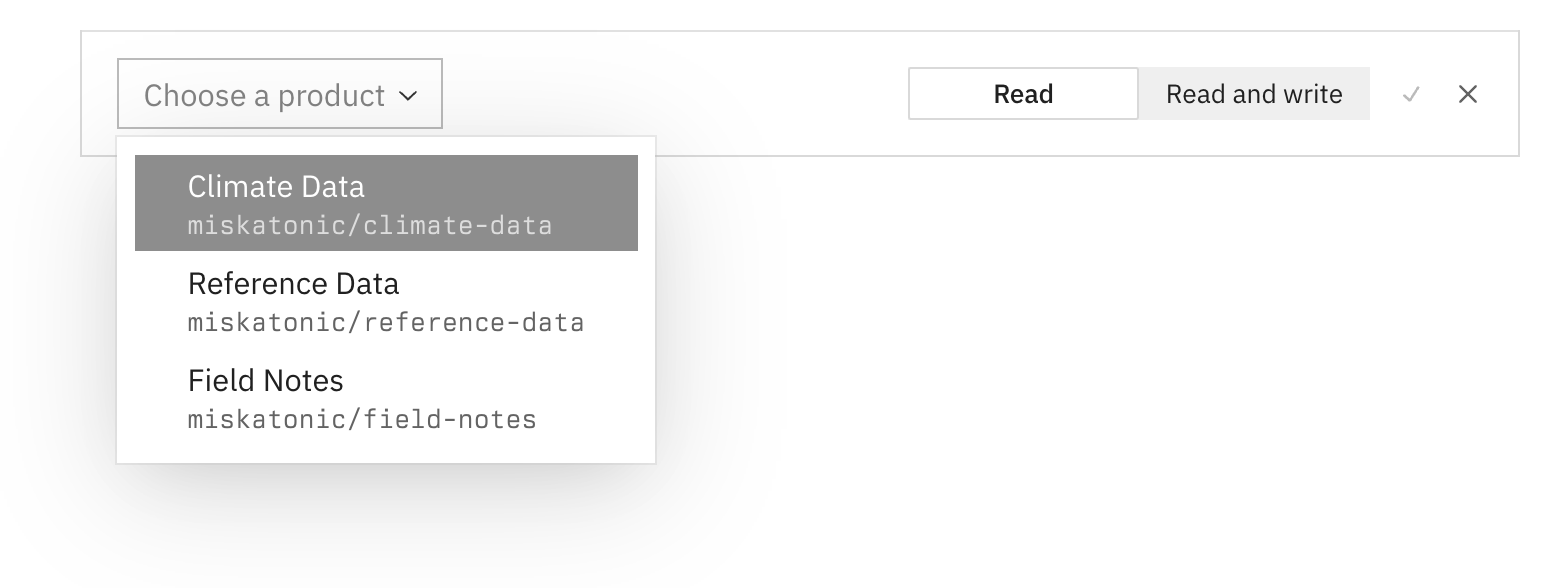 The create form uses the same list and grant row, and holds its grants until it is submitted. Example usage, opened from a workflow's row: 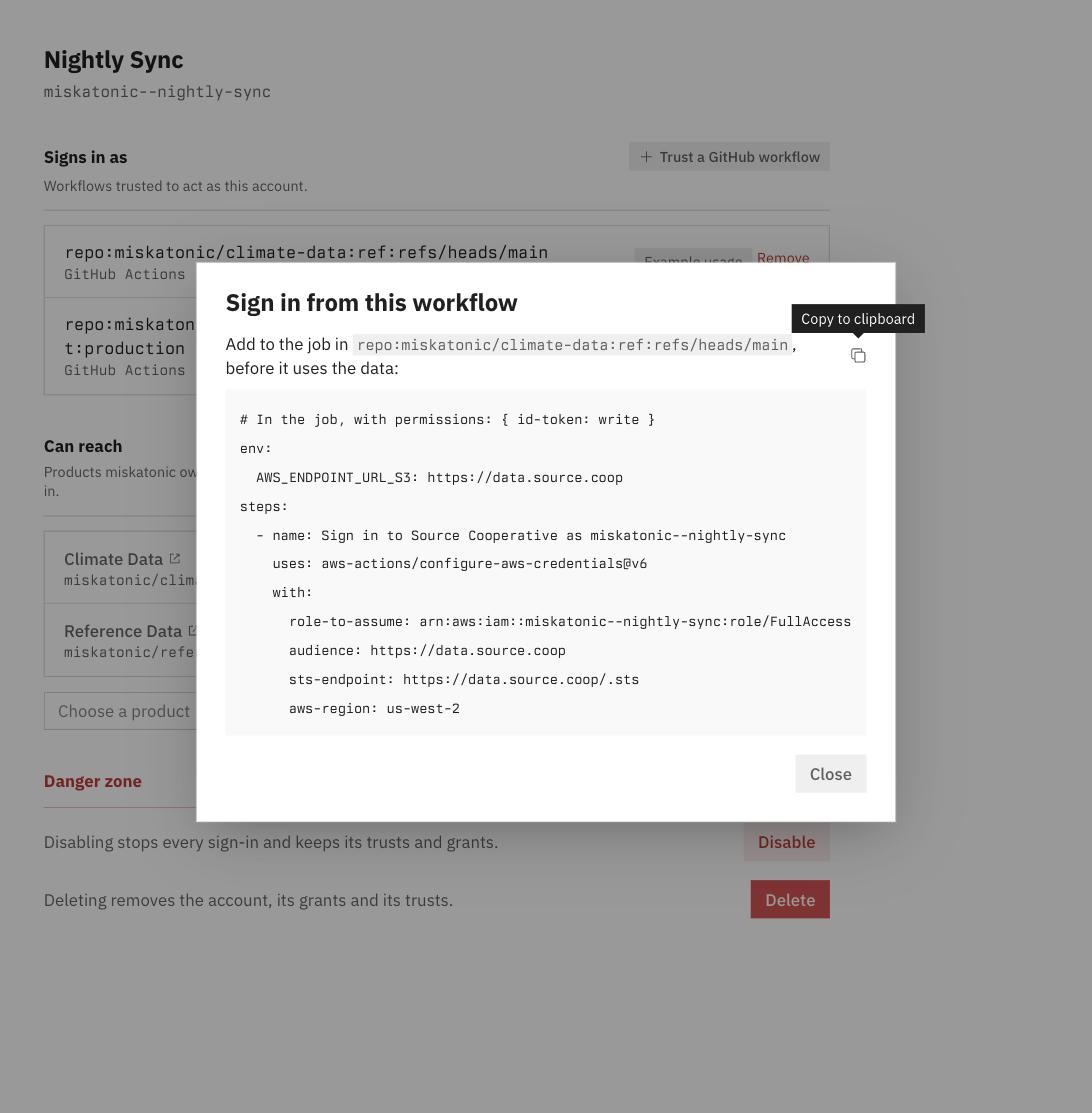 `WorkflowSnippet` on its own, with a subject in the immutable form pinned to an environment — the block scrolls sideways rather than wrapping the YAML: 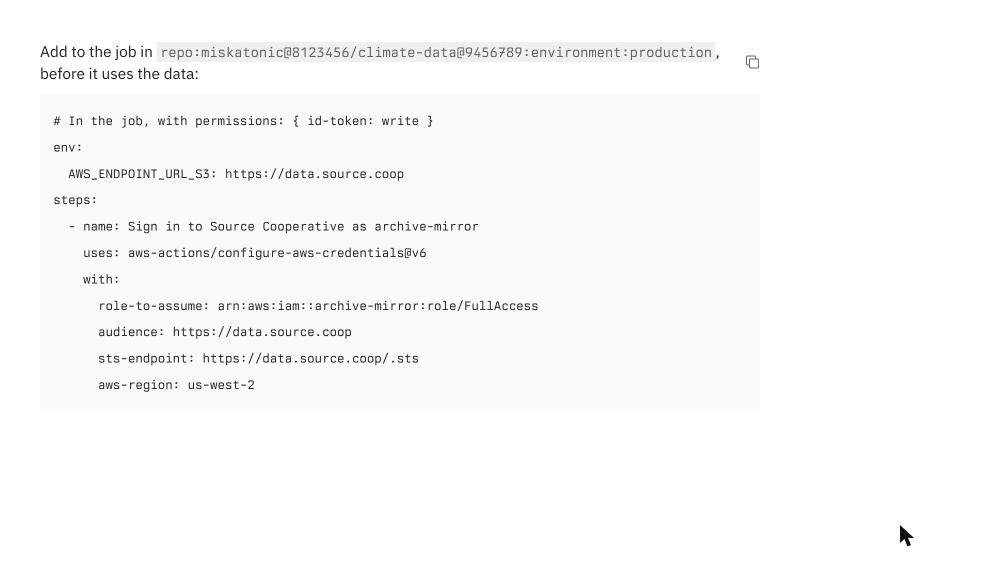 `GithubWorkflowFields` as the create form stacks it, an immutable repository name pinned to an environment, with the Remove button: 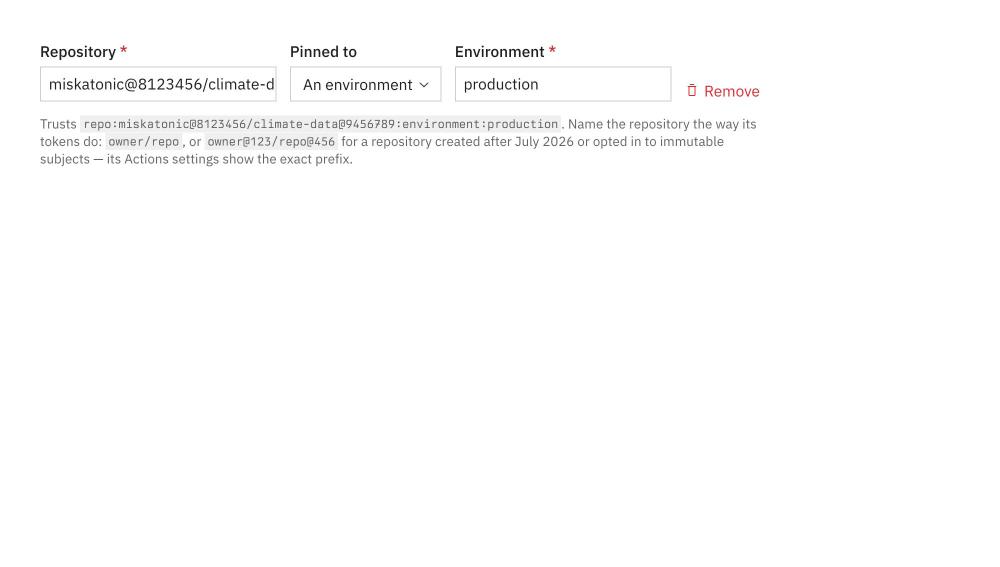 A service account's hover card: 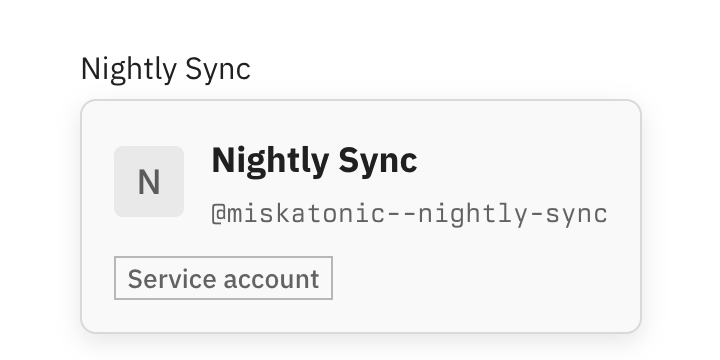 ## Testing - `npx jest` — all suites pass, re-run after the redesign. `service-accounts.test.ts`: create writes the account, grants and trusts once each however many times a field was posted, and redirects to the account's page; refuses an unpinned workflow, a product the owner lacks and a bad role before writing; refuses a non-manager, a missing owner and a service-account owner, and reports a taken id on the short-id field; delete removes grants then the account and redirects to the list; a short id containing its own `--` is refused; disable/enable; remove a trust by the account's key; trust one more workflow, refusing an unpinned subject, a repeat and a disabled account; every lifecycle action refuses what `managedServiceAccount` does not hand back. `accounts/service-accounts.test.ts`: the resolver hands back the account only when it is a service account whose owner is found and managed. `github-workflow.test.ts`: the step names the account and the proxy and carries nothing that expires. - `authz.test.ts`: the manager rules — admin-over-organization refused, some other account offered as the owner refused, a disabled owner refused for its managers and allowed for an admin. `account-trusts.test.ts`: write keyed by account and identity, only once; `AlreadyTrustedError`; malformed rows refused before the table; delete by the same key. - `service-accounts.test.ts`, `setProductAccess`: a product the account does not reach is granted as a member of the owner; one it reaches has its grant changed rather than a second added, and none revokes it (and is a no-op where there is no grant); a product the owner lacks, a role beyond read or write, and a non-manager are refused before any write; only the account's own grants are read. - `account-trusts.test.ts` also asserts the create condition names `identity` by placeholder. Unit tests mock DynamoDB, so they could not catch the reserved word; it surfaced when a trust write failed on a deployment with "Attribute name is a reserved keyword; reserved keyword: identity". - `npm run type-check`, `next lint`, `npm run build-storybook` — clean. ## Docs and ADRs data.source.coop: ADR-014 (source-cooperative/data.source.coop#232) describes this flow as amended with #566, and is amended again for the namespaced id (commit ae85ff72 on that PR), which replaces its "no reserved id namespace". docs.source.coop: the unattended-workflow guide (source-cooperative/docs.source.coop#34) will carry the workflow step this issues; it should read the way the AWS one does. 🤖 Generated with [Claude Code](https://claude.com/claude-code) https://claude.ai/code/session_01REZWKgQy2PDETn6j9YpM4z --------- Co-authored-by: Claude Fable 5.1 <noreply@anthropic.com>
3 of 4 tasks


PR #112 made /.sts a drop-in AssumeRoleWithWebIdentity target for AWS
SDK STS clients, which send parameters in a form-encoded POST body
rather than the query string. aws-actions/configure-aws-credentials
relies on that path. The integration suite only exercised the
query-string GET, so a regression in form-body parsing would go unnoticed.

- Extract XML->creds parsing into `_parse_sts_credentials`, shared by both
  the existing query GET helper and the new form-POST helper.
- Add `assume_role_form_post`, reproducing the exact wire request the action
  emits (application/x-www-form-urlencoded body via requests `data=`).
- Add `test_configure_aws_credentials_action_grants_write_access`: assume the
  github-actions role that way and prove a PUT/GET round-trip on
  private-uploads succeeds. Runs in the OIDC-gated class (id-token: write CI).

Co-Authored-By: Claude Opus 4.8 (1M context) <noreply@anthropic.com>
`aws-actions/configure-aws-credentials` (and other AWS tooling) validates
freshly assumed credentials by issuing an unconditional, SigV4-signed
`GetCallerIdentity` call before exporting them. multistore-sts only parsed
`AssumeRoleWithWebIdentity`, so the action could never succeed against the
proxy — it would retry GetCallerIdentity 12 times and then fail the step.
Closes #127.

- **`caller_identity`** (new module) — `handle_get_caller_identity` authenticates
  the call against the sealed session token: it recovers the minted credentials
  from `x-amz-security-token`, checks the auth-header access key matches, and
  verifies the SigV4 signature with the proxy's own `verify_sigv4_signature`
  over the recovered secret. AWS SDKs sign STS POSTs over the SHA-256 of the
  form body, usually without an `x-amz-content-sha256` header, so the payload
  hash is taken from that header when present and recomputed from the collected
  body otherwise. Verification runs over the raw signing path so the trailing
  slash AWS SDK JS v3 appends (`/.sts` -> `/.sts/`) is honored, not normalized.
- **`request::is_get_caller_identity`** — detects the action in a query string or
  form body (the two places AWS SDKs put STS parameters).
- **`responses`** — `build_caller_identity_response` emits STS-shaped
  `GetCallerIdentityResponse` XML. `Account` is the fabricated
  `SYNTHETIC_ACCOUNT_ID` (`000000000000`) — the proxy has no real AWS account —
  used consistently in the assumed-role ARN so the identity is coherent.
  `build_sts_error_response` now maps `SignatureDoesNotMatch`/`ExpiredCredentials`
  to STS-shaped 403s instead of a generic 500.
- **`route_handler`** — `StsHandler` dispatches GetCallerIdentity (authenticated,
  needs the full request) ahead of the unauthenticated assume-role exchange.
  `with_sts` now registers both `/.sts` and `/.sts/` (adding a `Clone` bound on
  the config) so SDK-JS callers, which hit the trailing-slash path, reach the
  handler.
- **docs** — `auth/proxy-auth.md` documents GetCallerIdentity, the synthetic
  account, the trailing-slash rule, and a `configure-aws-credentials` workflow
  example; `reference/operations.md` and `architecture/crate-layout.md` updated.

Co-Authored-By: Claude Opus 4.8 (1M context) <noreply@anthropic.com>
The Python suite only reproduced the action's wire requests. Now that the
proxy serves GetCallerIdentity (#127), run the actual action end to end and
prove the credentials it exports can write.

- **ci.yml** — after pytest, the `integration` job runs
  `aws-actions/configure-aws-credentials@v6` (SHA-pinned) with `sts-endpoint`
  pointed at the proxy, then `aws s3 cp` uploads/downloads/deletes an object in
  `private-uploads` using the exported credentials. The action's own mandatory
  GetCallerIdentity validation must pass for the step to succeed, so this covers
  the full assume-role -> validate -> use flow.
- **wrangler.integration.toml** — adds a role keyed by the full ARN
  `arn:aws:iam::000000000000:role/github-actions` (write scope on
  private-uploads). The action sends `role-to-assume` verbatim as the STS
  RoleArn and `get_role` matches `role_id` exactly, so the config key must be
  the full ARN; account `000000000000` matches the synthetic GetCallerIdentity
  account.
- **test_integration.py** — adds `test_get_caller_identity` (botocore signs a
  real GetCallerIdentity over the assumed creds; asserts the synthetic account
  and ARN) and `test_get_caller_identity_rejects_static_credentials` (no session
  token -> 403). Rescopes the earlier form-POST test to
  `test_sdk_form_post_assume_role_grants_write_access`, since the headline
  "action works" claim is now proven by the real action in CI.

Co-Authored-By: Claude Opus 4.8 (1M context) <noreply@anthropic.com>
alukach
force-pushed
the
worktree-aws-action-integration-test
branch
from
September 25, 2026 23:00
5906b30 to
f5f9068
Compare
alukach
added a commit
to source-cooperative/data.source.coop
that referenced
this pull request
Sep 25, 2026
The action requires the aws partition and validates with GetCallerIdentity (developmentseed/multistore#126).

Co-Authored-By: Claude Fable 5.1 <noreply@anthropic.com>
Claude-Session: https://claude.ai/code/session_01REZWKgQy2PDETn6j9YpM4z
alukach
added a commit
to source-cooperative/data.source.coop
that referenced
this pull request
Sep 25, 2026
A token from a platform issuer, GitHub Actions to begin with, now acts at `/.sts` as the account its `RoleArn` names (`arn:aws:iam::<account>:role/FullAccess`), and only if that account trusts the token's issuer and subject (ADR-014). The proxy reads the token's issuer unverified to route it, checks the Role and that `RoleArn` names an account, then verifies the token against the issuer's JWKS with that issuer's own audiences and a required `exp`, since multistore checks `exp` only when the claim is present. Only then does it ask `POST /api/v1/accounts/{account}/trusts/exchanges` with the verified issuer and subject, as the account. A yes is cached for 60 seconds per account, issuer and subject. A no, the route's 403, is not cached, so a trust just added works on the next attempt. The credentials' principal is the account, never the token's subject, and every refusal of the trust reads `AccessDenied: Not authorized to perform sts:AssumeRoleWithWebIdentity (request id …)`.

Platform issuers are configured in `PLATFORM_ISSUERS`, a JSON object from issuer to the audiences its tokens must carry, so that one issuer's audience never admits another's token (ADR-009); an issuer with no audience is refused. `AUTH_ISSUER` and `AUTH_AUDIENCE` still configure the person issuer, whose tokens act as their own subject as before. Production trusts GitHub with the proxy's origin as the audience, which is how source.coop's workflow snippet mints the token; staging and previews use staging's origin.

CI now configures GitHub as a platform issuer, as production does, and the stub answers the trusts route: yes for this repository's workflows on one account, no otherwise. The credentialed write tests name that account.

`aws-actions/configure-aws-credentials` still fails after a successful exchange, on `GetCallerIdentity`, until developmentseed/multistore#126 lands.

Co-Authored-By: Claude Opus 5.5 <noreply@anthropic.com>
Claude-Session: https://claude.ai/code/session_01R1eiTse4416N6uTgAy4Ddd
Since #146 a role with no required_audiences fails config validation at startup, because it could never accept a token. The role this PR adds for the configure-aws-credentials test had none, so wrangler dev refused the whole PROXY_CONFIG and every integration test failed. It now requires sts.amazonaws.com, the action's default audience and the one the other GitHub Actions roles use.

Co-Authored-By: Claude Opus 5.5 <noreply@anthropic.com>
Claude-Session: https://claude.ai/code/session_01R1eiTse4416N6uTgAy4Ddd
Align with the access-key check in auth/identity.rs by exporting
constant_time_eq from multistore::auth.

Co-Authored-By: Claude Opus 5.5 <noreply@anthropic.com>













alukach
added a commit
to source-cooperative/data.source.coop
that referenced
this pull request
Sep 29, 2026
A token from a platform issuer, GitHub Actions to begin with, now acts at `/.sts` as the account its `RoleArn` names (`arn:aws:iam::<account>:role/FullAccess`), and only if that account trusts the token's issuer and subject (ADR-014). The proxy reads the token's issuer unverified to route it, checks the Role and that `RoleArn` names an account, then verifies the token against the issuer's JWKS with that issuer's own audiences and a required `exp`, since multistore checks `exp` only when the claim is present. Only then does it ask `POST /api/v1/accounts/{account}/trusts/exchanges` with the verified issuer and subject, as the account. A yes is cached for 60 seconds per account, issuer and subject. A no, the route's 403, is not cached, so a trust just added works on the next attempt. The credentials' principal is the account, never the token's subject, and every refusal of the trust reads `AccessDenied: Not authorized to perform sts:AssumeRoleWithWebIdentity (request id …)`.

Platform issuers are configured in `PLATFORM_ISSUERS`, a JSON object from issuer to the audiences its tokens must carry, so that one issuer's audience never admits another's token (ADR-009); an issuer with no audience is refused. `AUTH_ISSUER` and `AUTH_AUDIENCE` still configure the person issuer, whose tokens act as their own subject as before. Production trusts GitHub with the proxy's origin as the audience, which is how source.coop's workflow snippet mints the token; staging and previews use staging's origin.

CI now configures GitHub as a platform issuer, as production does, and the stub answers the trusts route: yes for this repository's workflows on one account, no otherwise. The credentialed write tests name that account.

`aws-actions/configure-aws-credentials` still fails after a successful exchange, on `GetCallerIdentity`, until developmentseed/multistore#126 lands.

Co-Authored-By: Claude Opus 5.5 <noreply@anthropic.com>
Claude-Session: https://claude.ai/code/session_01R1eiTse4416N6uTgAy4Ddd
alukach
added a commit
to source-cooperative/data.source.coop
that referenced
this pull request
Sep 29, 2026
A token from a platform issuer, GitHub Actions to begin with, now acts at `/.sts` as the account its `RoleArn` names (`arn:aws:iam::<account>:role/FullAccess`), and only if that account trusts the token's issuer and subject (ADR-014). The proxy reads the token's issuer unverified to route it, checks the Role and that `RoleArn` names an account, then verifies the token against the issuer's JWKS with that issuer's own audiences and a required `exp`, since multistore checks `exp` only when the claim is present. Only then does it ask `POST /api/v1/accounts/{account}/trusts/exchanges` with the verified issuer and subject, as the account. A yes is cached for 60 seconds per account, issuer and subject. A no, the route's 403, is not cached, so a trust just added works on the next attempt. The credentials' principal is the account, never the token's subject, and every refusal of the trust reads `AccessDenied: Not authorized to perform sts:AssumeRoleWithWebIdentity (request id …)`.

Platform issuers are configured in `PLATFORM_ISSUERS`, a JSON object from issuer to the audiences its tokens must carry, so that one issuer's audience never admits another's token (ADR-009); an issuer with no audience is refused. `AUTH_ISSUER` and `AUTH_AUDIENCE` still configure the person issuer, whose tokens act as their own subject as before. Production trusts GitHub with the proxy's origin as the audience, which is how source.coop's workflow snippet mints the token; staging and previews use staging's origin.

CI now configures GitHub as a platform issuer, as production does, and the stub answers the trusts route: yes for this repository's workflows on one account, no otherwise. The credentialed write tests name that account.

`aws-actions/configure-aws-credentials` still fails after a successful exchange, on `GetCallerIdentity`, until developmentseed/multistore#126 lands.

Co-Authored-By: Claude Opus 5.5 <noreply@anthropic.com>
Claude-Session: https://claude.ai/code/session_01R1eiTse4416N6uTgAy4Ddd
alukach
added a commit
to source-cooperative/data.source.coop
that referenced
this pull request
Sep 30, 2026
On `main`, now that #235 is merged; two commits. **How to test it**
lists what I ran locally.

## What I'm changing

`/.sts` serves three hardcoded Roles instead of one, for ID tokens and
API keys alike, as ADR-014 (#232) specifies:

| Role | Credentials may |
| --- | --- |
| `FullAccess` | do everything the account's memberships allow |
| `ReadOnly` | do the same, except write |
| `_default` | do what `FullAccess` does; kept because deployed clients
name it |

- **Names.** Each Role is accepted bare or as the `role/<name>` resource
of an ARN of any partition and account
(`arn:aws:iam::000000000000:role/ReadOnly`), because SDKs check the ARN
shape before sending. A pathed resource (`role/team/ReadOnly`), another
case (`readonly`) or any other name is `RoleNotFound`, never a fallback
to a default.
- **The ceiling.** `ReadOnly` seals one scope into the session token's
`allowed_scopes`: every product (`*`), read actions only (`GetObject`,
`HeadObject`, `ListBucket`). The gateway never calls multistore's own
scope check (`auth::authorize`), because this proxy's registry is the
authorizer, so the registry enforces it. `get_bucket` checks the ceiling
first, before any Source API lookup, and refuses with the same
`AccessDenied` as every other refusal (ADR-011, Denial Semantics). An
INFO log line is the only record of why.
- **It only subtracts.** A write the ceiling allows still needs the
account's own write permission, fetched as before.
- **No scopes, no ceiling.** `FullAccess` and `_default` seal no scopes,
as `_default` never has, so every session already issued keeps working.
A `_default` exchange returns the same response as before,
`AssumedRoleId` included.
- **Both entry points.** The STS route
(`StsCredentialRegistry::get_role`) and the API-key exchange
(`exchange_api_key`, which accepted only `_default`) share one lookup,
`sts::role`. The key exchange's log line now names the Role.

source.coop `main`'s GitHub integration snippet
(`src/lib/services/github-workflow.ts`) already hands out
`arn:aws:iam::<service-account-id>:role/FullAccess`. This PR makes that
Role name resolve. The rest of that path is the next PR in this stack,
which trusts a GitHub token for the account it names (#222, #223), plus
`GetCallerIdentity` in developmentseed/multistore#126.

**Decisions to flag**

- **The first comment on #221 is superseded.** It says `ReadOnly` cannot
be enforced until multistore plumbs the assumed Role through to the
registry. That isn't needed: what is sealed is the Role's ceiling, not
its name, and `AuthenticatedIdentity.allowed_scopes` already reaches
`BucketRegistry::get_bucket` (multistore 0.7.2, `auth/identity.rs`). No
multistore change.
- **The ceiling understands only what the two Roles need**: a scope over
every product (`*`) with no prefix. A scope naming one product or a
prefix permits nothing rather than being half-interpreted. ADR-011's
resource matching can arrive with account-owned Roles. The `*` sentinel
means something only to this proxy, because multistore's exact-match
`authorize` never runs here.
- **Empty scopes mean no ceiling in the registry.** This is the reverse
of multistore's `authorize`, where empty means deny-all, as ADR-001
noted. It is safe because only this proxy mints session tokens, sealed
with `SESSION_TOKEN_KEY`, and every `_default` session carries empty
scopes.
- **`ReadOnly` excludes `GetObjectVersion`** (reading a versioned copy
source). The write gate already classes it as a write, and a native test
pins that the ceiling and `is_write_action` agree on every action. That
is the divergence ADR-011 warns about.
- **ARNs are now parsed as six colon-separated fields with a
`role/<name>` resource.** The old `_default` check matched only the
`arn:` prefix and the `:role/_default` suffix, so it also accepted
malformed strings such as `arn:role/_default`. Those are now refused,
and no SDK sends them anyway: they fail the SDKs' own 20-character
minimum.

## How I did it

- `src/sts.rs`: `role(role_arn, issuer, audiences, max_session)` returns
the named Role or `None`, replacing `default_role` and
`is_default_role`. `ALL_PRODUCTS` is the `*` sentinel.
- `src/authz.rs`: `ceiling_permits(scopes, action)`.
- `src/source_api/registry.rs`: the check at the top of `get_bucket`.
- `src/lib.rs`: the key exchange resolves the named Role before its
lookup, as before, and mints under it.
- `README.md`: a Roles section. `adrs/001`, `004` and `011`, in a
separate commit: see below.

## How to test it

- `cargo test`: all suites pass. `tests/sts.rs` covers bare and ARN
names for all three Roles, including a service-account-shaped account
segment, and refusal of unknown, lower-case, pathed, suffixed and
non-role names. `tests/authz.rs` covers that `ReadOnly`'s sealed ceiling
allows exactly the actions `is_write_action` calls reads, that
`FullAccess` and `_default` allow every action, and that narrower scopes
permit nothing. `tests/keys.rs` checks that a `ReadOnly` key's session
unseals with `ReadOnly`'s ceiling.
- `cargo fmt --check`, `cargo clippy --target wasm32-unknown-unknown --
-D warnings` and `cargo check --target wasm32-unknown-unknown`, through
the pre-commit hook.
- `pytest tests/ --ignore=tests/test_contract.py` against `wrangler dev`
(wrangler 3.114) and `tests/stub_api.py`: 35 passed, 15 skipped. The
skipped ones are the credentialed tests that need CI's GitHub token. The
new `test_read_only_refuses_a_write_before_anything_is_looked_up`
exchanges the stub's live key for `ReadOnly` and for `FullAccess`, then
writes to a product the stub has never heard of. `ReadOnly` gets
`AccessDenied`. `FullAccess` gets past the ceiling to the product lookup
and gets `NoSuchBucket`, and so does a `ReadOnly` read. The upstream
write itself fails closed in CI, so the product lookup is where the
ceiling's path can be told apart. I also disabled the check, saw this
test fail (`ReadOnly` got `NoSuchBucket`), and restored it.

## Docs and ADRs

- **ADR-011** (Role-Ceiling Authorization) still describes the model.
This PR implements its step 2 and its denial semantics for the two
hardcoded Roles, so its status line now says it is implemented in part.
- **ADR-004** described "a single built-in Role, `_default`". A note
under that section now points to ADR-014 and this PR, and ADR-004's
"Implemented by" line lists this PR.
- **ADR-001** said `assumed_role_id` is "currently always `_default`"
and that the sealed `allowed_scopes` is empty and "not enforced on this
path". Its credential table now names the three Roles and their
ceilings. Its bullet now says the registry enforces the ceiling and
reads empty as no ceiling.
- **ADR-014** (#232) says "two Roles are hardcoded, `FullAccess` and
`ReadOnly`, with `_default` kept as an alias (#221)". This PR implements
that, so it still holds. ADR-010's scope note is ADR-014's amendment and
also holds.
- **ADR-013 as revised** (#234) says a key's "role must be one the proxy
serves". That still holds, and keys can now name all three Roles.
- **docs.source.coop**: no page on `main` describes `/.sts` or its Roles
yet. The unattended-workflow guide,
source-cooperative/docs.source.coop#34, is where the Role names belong.

## PR Checklist

- [x] This PR has **no** breaking changes. `_default` behaves and
answers as before; only malformed ARNs that no SDK can send are newly
refused.
- [x] I have updated or added new tests to cover the changes in this PR.
- [x] This PR affects the [Source Cooperative Frontend &
API](https://github.com/source-cooperative/source.coop): source.coop
`main`'s GitHub snippet names `role/FullAccess`, which resolves from
this PR on. No source.coop change is needed.

## Related Issues

Closes #221. Builds on #235, merged. ADRs: #232 (ADR-014), #234 (ADR-013
revised). Epic: source-cooperative/source.coop#491.

🤖 Generated with [Claude Code](https://claude.com/claude-code)

https://claude.ai/code/session_01R1eiTse4416N6uTgAy4Ddd

---------

Co-authored-by: Claude Opus 5.5 <noreply@anthropic.com>
alukach
added a commit
to source-cooperative/data.source.coop
that referenced
this pull request
Sep 30, 2026
A token from a platform issuer, GitHub Actions to begin with, now acts at `/.sts` as the account its `RoleArn` names (`arn:aws:iam::<account>:role/FullAccess`), and only if that account trusts the token's issuer and subject (ADR-014). The proxy reads the token's issuer unverified to route it, checks the Role and that `RoleArn` names an account, then verifies the token against the issuer's JWKS with that issuer's own audiences and a required `exp`, since multistore checks `exp` only when the claim is present. Only then does it ask `POST /api/v1/accounts/{account}/trusts/exchanges` with the verified issuer and subject, as the account. A yes is cached for 60 seconds per account, issuer and subject. A no, the route's 403, is not cached, so a trust just added works on the next attempt. The credentials' principal is the account, never the token's subject, and every refusal of the trust reads `AccessDenied: Not authorized to perform sts:AssumeRoleWithWebIdentity (request id …)`.

Platform issuers are configured in `PLATFORM_ISSUERS`, a JSON object from issuer to the audiences its tokens must carry, so that one issuer's audience never admits another's token (ADR-009); an issuer with no audience is refused. `AUTH_ISSUER` and `AUTH_AUDIENCE` still configure the person issuer, whose tokens act as their own subject as before. Production trusts GitHub with the proxy's origin as the audience, which is how source.coop's workflow snippet mints the token; staging and previews use staging's origin.

CI now configures GitHub as a platform issuer, as production does, and the stub answers the trusts route: yes for this repository's workflows on one account, no otherwise. The credentialed write tests name that account.

`aws-actions/configure-aws-credentials` still fails after a successful exchange, on `GetCallerIdentity`, until developmentseed/multistore#126 lands.

Co-Authored-By: Claude Opus 5.5 <noreply@anthropic.com>
Claude-Session: https://claude.ai/code/session_01R1eiTse4416N6uTgAy4Ddd
alukach
added a commit
to source-cooperative/data.source.coop
that referenced
this pull request
Sep 30, 2026
A token from a platform issuer, GitHub Actions to begin with, now acts at `/.sts` as the account its `RoleArn` names (`arn:aws:iam::<account>:role/FullAccess`), and only if that account trusts the token's issuer and subject (ADR-014). The proxy reads the token's issuer unverified to route it, checks the Role and that `RoleArn` names an account, then verifies the token against the issuer's JWKS with that issuer's own audiences and a required `exp`, since multistore checks `exp` only when the claim is present. Only then does it ask `POST /api/v1/accounts/{account}/trusts/exchanges` with the verified issuer and subject, as the account. A yes is cached for 60 seconds per account, issuer and subject. A no, the route's 403, is not cached, so a trust just added works on the next attempt. The credentials' principal is the account, never the token's subject, and every refusal of the trust reads `AccessDenied: Not authorized to perform sts:AssumeRoleWithWebIdentity (request id …)`.

Platform issuers are configured in `PLATFORM_ISSUERS`, a JSON object from issuer to the audiences its tokens must carry, so that one issuer's audience never admits another's token (ADR-009); an issuer with no audience is refused. `AUTH_ISSUER` and `AUTH_AUDIENCE` still configure the person issuer, whose tokens act as their own subject as before. Production trusts GitHub with the proxy's origin as the audience, which is how source.coop's workflow snippet mints the token; staging and previews use staging's origin.

CI now configures GitHub as a platform issuer, as production does, and the stub answers the trusts route: yes for this repository's workflows on one account, no otherwise. The credentialed write tests name that account.

`aws-actions/configure-aws-credentials` still fails after a successful exchange, on `GetCallerIdentity`, until developmentseed/multistore#126 lands.

Co-Authored-By: Claude Opus 5.5 <noreply@anthropic.com>
Claude-Session: https://claude.ai/code/session_01R1eiTse4416N6uTgAy4Ddd
alukach
added a commit
to source-cooperative/data.source.coop
that referenced
this pull request
Sep 30, 2026
A token from a platform issuer, GitHub Actions to begin with, now acts at `/.sts` as the account its `RoleArn` names (`arn:aws:iam::<account>:role/FullAccess`), and only if that account trusts the token's issuer and subject (ADR-014). The proxy reads the token's issuer unverified to route it, checks the Role and that `RoleArn` names an account, then verifies the token against the issuer's JWKS with that issuer's own audiences and a required `exp`, since multistore checks `exp` only when the claim is present. Only then does it ask `POST /api/v1/accounts/{account}/trusts/exchanges` with the verified issuer and subject, as the account. A yes is cached for 60 seconds per account, issuer and subject. A no, the route's 403, is not cached, so a trust just added works on the next attempt. The credentials' principal is the account, never the token's subject, and every refusal of the trust reads `AccessDenied: Not authorized to perform sts:AssumeRoleWithWebIdentity (request id …)`.

Platform issuers are configured in `PLATFORM_ISSUERS`, a JSON object from issuer to the audiences its tokens must carry, so that one issuer's audience never admits another's token (ADR-009); an issuer with no audience is refused. `AUTH_ISSUER` and `AUTH_AUDIENCE` still configure the person issuer, whose tokens act as their own subject as before. Production trusts GitHub with the proxy's origin as the audience, which is how source.coop's workflow snippet mints the token; staging and previews use staging's origin.

CI now configures GitHub as a platform issuer, as production does, and the stub answers the trusts route: yes for this repository's workflows on one account, no otherwise. The credentialed write tests name that account.

`aws-actions/configure-aws-credentials` still fails after a successful exchange, on `GetCallerIdentity`, until developmentseed/multistore#126 lands.

Co-Authored-By: Claude Opus 5.5 <noreply@anthropic.com>
Claude-Session: https://claude.ai/code/session_01R1eiTse4416N6uTgAy4Ddd
This branch was successfully deployed
This file contains hidden or bidirectional Unicode text that may be interpreted or compiled differently than what appears below. To review, open the file in an editor that reveals hidden Unicode characters.
Learn more about bidirectional Unicode characters
Sign up for free
to join this conversation on GitHub.
Already have an account?
Sign in to comment
1 participant

Add this suggestion to a batch that can be applied as a single commit.This suggestion is invalid because no changes were made to the code.Suggestions cannot be applied while the pull request is closed.Suggestions cannot be applied while viewing a subset of changes.Only one suggestion per line can be applied in a batch.Add this suggestion to a batch that can be applied as a single commit.Applying suggestions on deleted lines is not supported.You must change the existing code in this line in order to create a valid suggestion.Outdated suggestions cannot be applied.This suggestion has been applied or marked resolved.Suggestions cannot be applied from pending reviews.Suggestions cannot be applied on multi-line comments.Suggestions cannot be applied while the pull request is queued to merge.Suggestion cannot be applied right now. Please check back later.
What I'm changing
aws-actions/configure-aws-credentialsis the flagship consumer of the STS endpoint, but it could never work against the proxy: afterAssumeRoleWithWebIdentityit issues an unconditional, SigV4-signedGetCallerIdentitycall to validate the credentials before exporting them (no opt-out; 12 retries then the step fails). multistore-sts only parsedAssumeRoleWithWebIdentity, so that call fell through unhandled.This PR implements
GetCallerIdentity(closes #127) and adds an integration test that runs the real action end to end and proves the credentials it exports can write.How I did it
STS crate —
GetCallerIdentity(#127)caller_identity(new module): authenticates the call against the sealed session token — recovers the minted credentials fromx-amz-security-token, checks the auth-header access key matches, and verifies the SigV4 signature with the proxy's ownverify_sigv4_signature. Payload hash comes fromx-amz-content-sha256when present, else recomputed from the collected form body (AWS SDKs sign STS POSTs over the body hash, often without the header). Verifies over the raw signing path so the trailing slash AWS SDK JS v3 appends (/.sts->/.sts/) is honored, not normalized.request::is_get_caller_identitydetects the action in a query string or form body.responses::build_caller_identity_responseemits STS-shaped XML.Accountis the fabricatedSYNTHETIC_ACCOUNT_ID(000000000000) — the proxy has no real AWS account — used consistently in the assumed-role ARN.build_sts_error_responsenow mapsSignatureDoesNotMatch/ExpiredCredentialsto STS-shaped 403s.route_handler: dispatches GetCallerIdentity ahead of the assume-role exchange;with_stsregisters both/.stsand/.sts/(adds aClonebound) so SDK-JS callers reach the handler.Integration test — the real action
ci.yml: theintegrationjob now runsaws-actions/configure-aws-credentials@v6(SHA-pinned) withsts-endpointat the proxy, thenaws s3 cpround-trips an object inprivate-uploadswith the exported credentials. The action's own GetCallerIdentity validation must pass for the step to succeed.wrangler.integration.toml: adds a role keyed by the full ARNarn:aws:iam::000000000000:role/github-actions(write scope), since the action sendsrole-to-assumeverbatim as the RoleArn andget_rolematchesrole_idexactly.test_integration.py: addstest_get_caller_identity(botocore signs a real GetCallerIdentity over the assumed creds) andtest_get_caller_identity_rejects_static_credentials; rescopes the earlier form-POST test totest_sdk_form_post_assume_role_grants_write_access.Docs:
auth/proxy-auth.md(GetCallerIdentity, synthetic account, trailing-slash rule,configure-aws-credentialsworkflow example),reference/operations.md,architecture/crate-layout.md.Test plan
cargo test -p multistore-sts(35 pass),cargo fmt,cargo clippy --fixcargo check --all-targets,cargo check -p multistore-cf-workers --target wasm32-unknown-unknownintegrationCI job: real action assume-role -> GetCallerIdentity validation ->aws s3 cpwrite, plus the two new OIDC-gated pytest cases. The signed GetCallerIdentity happy-path is verified in CI (botocore + the action), not locally — locally I audited the exact inputs handed toverify_sigv4_signature.🤖 Generated with Claude Code