This software is derived from https://github.com/threeme3/usdx but it has been completely rewritten for ESP32-S3 N16R8 Devkit C1.
Its hardware is here https://hackaday.io/project/205224-esp32-hf-qrp-ft8-transceiver
This project implements a full IQ SDR receiver and FT8 transceiver on an ESP32 using external RF front-end circuitry. It includes DSP processing, FT8 embedded coding and decoding, audio output via I2S, network audio streaming, and automatic antenna band filtering.
- True IQ SDR processing: LSB/USB/AM/CW demodulation
- High-quality ADC interface: PCM1808
- CIC decimation and DC removal
- IQ amplitude/phase calibration
- Selectable audio filters and AGC
- Volume control and RIT support
- Network audio streaming (websocket) over Wi-Fi or Ethernet
- Web Server for remote operations over Wi-Fi or Ethernet
- Automatic antenna filter selection via MCP23017 GPIO
- FT8 TX and RX support with frequency optimization
- FT8 embedded coding and decoding using my library https://github.com/guido57/ESP32_ft8_lib
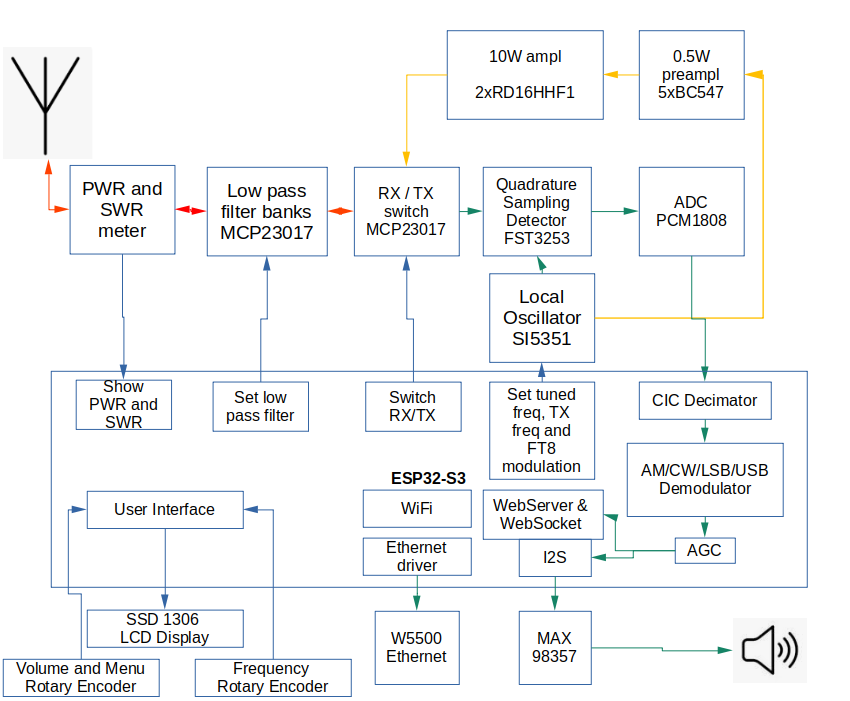
- Tayloe / QSD detector for I/Q extraction
- Connected to PCM1808 ADC via I2S
- Optional analog pre-filtering per HF band
PCM1808 ADC → CIC Decimator → DC Removal → IQ Calibration → Demodulator → Audio Filter → AGC → Volume → I2S / Wi-Fi
- CIC Decimation: 32 kHz → 8 kHz audio
- IQ Calibration: corrects phase and amplitude imbalance
- Demodulator: supports LSB, USB, AM, CW
- Audio Filter: selectable bandwidth for each mode
- AGC: peak limiting, attack/release control
- Audio Output: I2S DAC (MAX98357) or Wi-Fi streaming
- SI5351 driver for local oscillator generation
- UI-controlled frequency, mode, and filter selection
- Automatic antenna filter switching via MCP23017
- Filter selection rules:
< 4 MHz→ 1.8 / 3.5 MHz< 10 MHz→ 5 / 7 MHz< 30 MHz→ 14 / 21 / 28 MHz> 30 MHz→ bypass all
- Integrated FT8 TX engine
- Frequency optimization to avoid interferences
- For FT8 decoding, it continuosly streams audio to an external server where a python program:
- receives audio
- every 15 seconds runs a command line FT8 decoder (the same used by WSJT-X) to obtain the decoded messages
- sends back decoded messages to the ESP32
loop():
 ├── ui_loop()                (UI interaction)
 ├── processAudioPCM1808()    (DSP pipeline)
 ├── SI5351 update if needed
 ├── antenna filter update
 ├── TX bias control
 └── periodic FT8 frequency optimization
- ESP32 (any ESP32 variant with enough flash should work). I used ESP32-S3 N16R8 i.e. 16MB Flash, 8MB PSRAM
- PCM1808 ADC
- MAX98357 DAC (I2S audio)
- SI5351 frequency synthesizer
- MCP23017 for antenna relay switching
- Tayloe / QSD or other IQ front-end
- W5500 (optional) for Ethernet
- Designed for efficient CPU usage on ESP32
- DSP pipeline supports real-time audio at 8 kHz
- Wi-Fi streaming allows network SDR operation
- Built-in calibration tools for IQ imbalance and clipping detection
I adopted a custom partitioning as you can see in my mypartitions.csv
 Name,   Type, SubType, Offset,   Size, Flags
nvs,      data, nvs,      0x9000,   0x5000,
otadata,  data, ota,      0xe000,   0x2000,
app0,     app,  ota_0,    0x10000,  0x300000,
app1,     app,  ota_1,    0x310000, 0x300000,
logs,     data, spiffs,   0x610000, 0x200000,
spiffs,   data, spiffs,   0x810000, 0x200000,
coredump, data, coredump, 0xA10000, 0x20000,
I halved "data" into "logs" and "spiffs", both with a length of 0x200000 bytes:
- logs is read/written by the program (see qsostats.cpp) to persist QSO scoring but it is not overwritten when I run 'pio run --target uploadfs'
- spiffs contains all the files for the web server (index.html, app.js and so on), it is written with all the files contained in /data using 'pio run --target uploadfs' and it is read (only) by the program
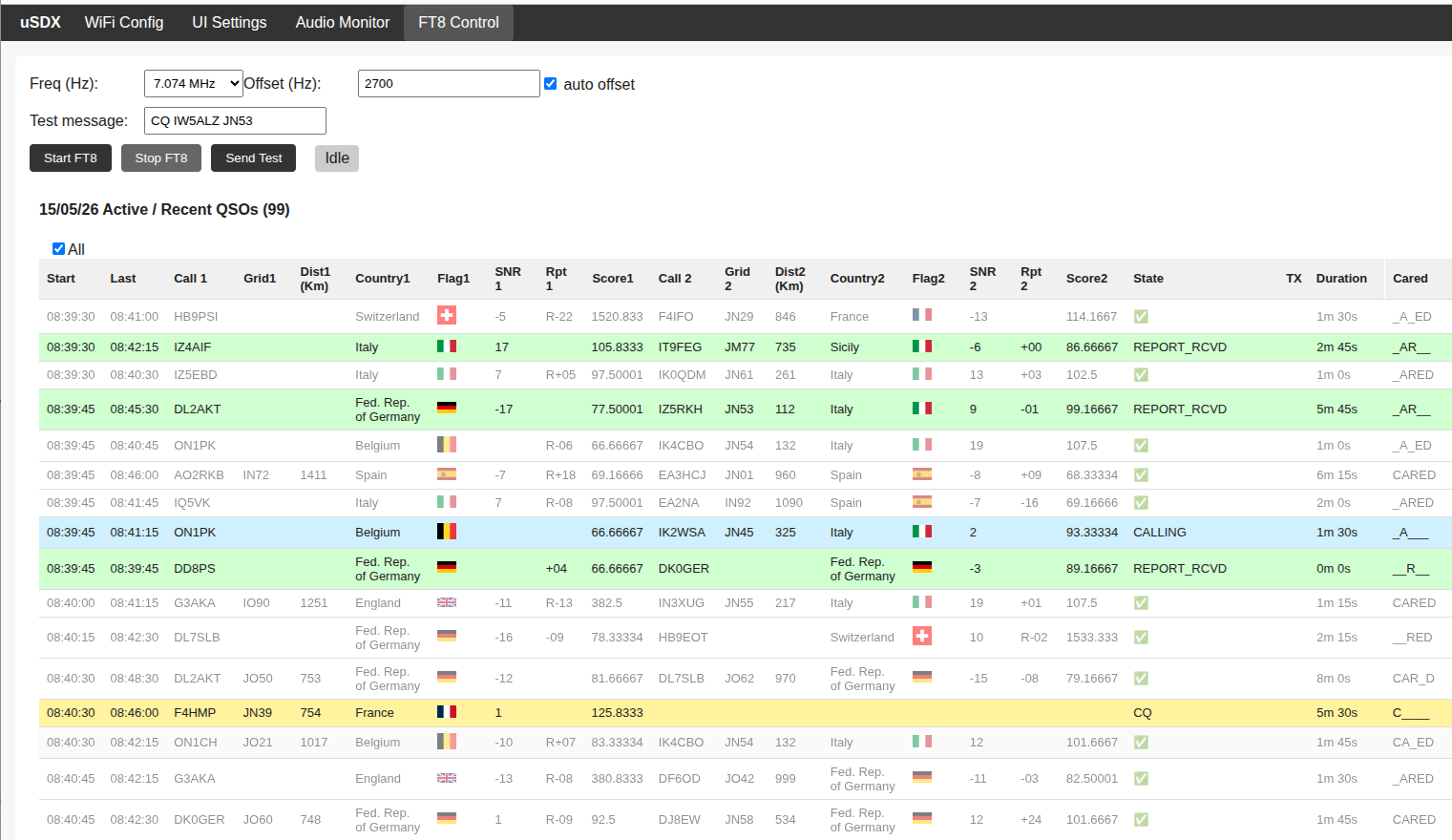


- answer a CQ double clicking a row
- follow the evolution of your or other QSOs
- make a CQ or any other manual FT8 message
- set or disable the automatic frequency offset
- change the FT8 band (160, 80, 60, 40, 30, 20, 15, 10 meters)