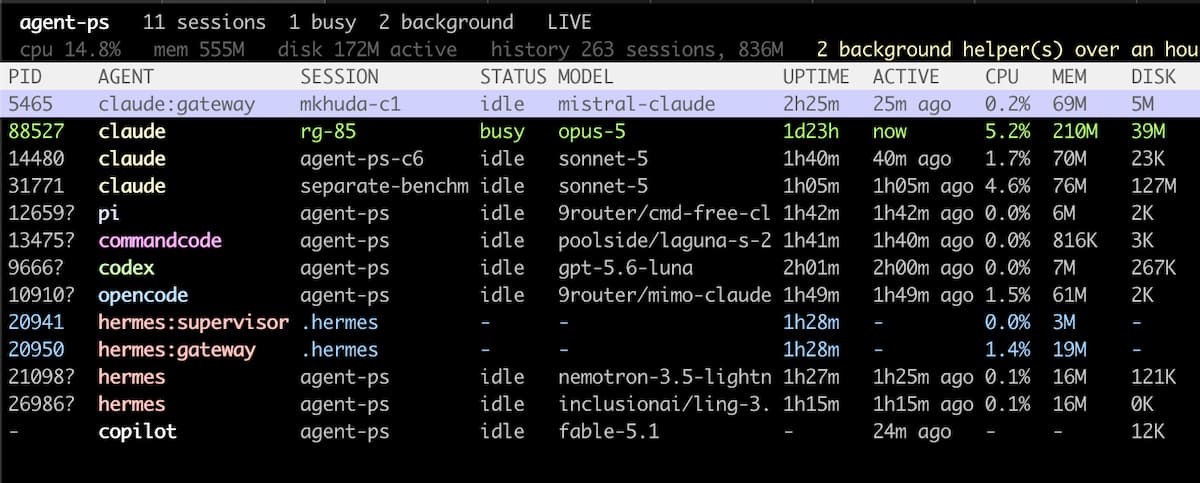
A process table for coding agent sessions, the way ps would look if it knew
what a session was.



Install | Usage | Agents | Scripting | How it works
curl -fsSL https://raw.githubusercontent.com/mkhuda/agent-ps/main/install.sh | sh
ps aux | grep claude gives you PIDs. It will not tell you which one is the
session you are talking to, what model it is spending on, whether it has been
idle for three days, or which rows are background daemons that outlived the
terminal that started them. It also misses the other seven agents entirely.
agent-ps lists every session with its agent, model, working directory, uptime, idle time and disk footprint, then stops one process tree, every background helper, or the lot.
One file, no dependencies, reads local files only.
curl -fsSL https://raw.githubusercontent.com/mkhuda/agent-ps/main/install.sh | shTakes the latest release, checks it against the checksum published beside it,
makes sure it runs, and puts the single file in ~/.local/bin. Set BIN_DIR to
install elsewhere, or AGENT_PS_REF=v0.1.0 to pin a version.
From PyPI, which installs the program itself:
uvx agent-ps                  # run it once
pipx install agent-ps         # keep it, isolated
pip install agent-ps          # keep it, wherever pip points
From npm, which carries the same single executable and finds an interpreter for it:
npx @mkhuda/agent-ps
pnpm dlx @mkhuda/agent-ps
bunx @mkhuda/agent-ps
Either way the command it gives you is agent-ps.
If you would rather not pipe a script into a shell, the executable is the whole program:
mkdir -p ~/.local/bin
curl -fsSL -o ~/.local/bin/agent-ps \
  https://github.com/mkhuda/agent-ps/releases/latest/download/agent-ps
chmod +x ~/.local/bin/agent-ps
Every release publishes a
SHA256SUMS next to it.
git clone https://github.com/mkhuda/agent-ps && cd agent-ps
./install.sh
Builds from the tree rather than downloading, so you install what you are looking at.
Python 3.8 or later and nothing from PyPI. Tested on 3.8, 3.9, 3.12 and 3.13.
macOS and Linux; Windows is out because curses is not in its standard library.
It shells out to ps, and on macOS to lsof, which is how a process is matched
to a session everywhere except Claude Code.
rm -f ~/.local/bin/agent-psThat is the whole uninstall. Nothing is written outside that directory, and agent-ps only ever reads the agents' own files.
Each agent keeps its own colour in the table, and the same colours label the legend above the keys.
| Agent | Sessions in | Paired by | Reopened with | |
|---|---|---|---|---|
| Claude Code |  |
JSONL | the agent itself | claude --resume |
| Pi |  |
JSONL | directory | pi --session |
| CommandCode |  |
JSONL | directory | cmd --resume |
| Codex CLI |  |
JSONL | directory | codex resume |
| OpenCode |  |
SQLite | directory | opencode --session |
| Hermes |  |
SQLite | directory | hermes --resume |
| GitHub Copilot |  |
VS Code storage | no process | in the editor |
| Antigravity |  |
SQLite per conversation | directory | agy --conversation |
Only Claude Code records which process is running which session. Every other pairing is matched on working directory and shown as a guess. Tokens and cost appear in the detail panel.
Copilot is the exception: it runs inside the VS Code extension host, so it has no process of its own and nothing to stop. A chat counts as open while its workspace is open in the editor.
Run without arguments for the live table:
agent-psIt refreshes every two seconds and stays out of the way until you act on something.
| Key | Action |
|---|---|
| up, down | move the selection |
j, K |
down and up, since k is taken by stop |
| home, end | jump to the first or last row |
| enter | details for a live session, or reopen an ended one |
s |
cycle the sort column |
S |
reverse the direction |
k |
stop the selected process and its children, after confirming |
b |
stop every background helper, after confirming |
p |
remove what the selected ended session left behind, after confirming |
y, n |
answer a confirmation |
e |
show or hide ended sessions |
/ |
filter by session, title, agent, model, directory, or PID |
| esc | leave filter mode, or close the detail panel |
| space | pause refreshing |
r |
refresh now |
q |
quit |
Those keys live at the bottom of the screen, under a line naming every agent on screen in its own colour and, on the right, what the table is sorted by:

That middle line is the key to the colours, names the sort order in words, and is where a note appears for a few seconds after you act on something.
Backspacing a filter down to nothing leaves filter mode, so the key bar comes back without reaching for escape.
s cycles the sort column through agent, active, disk, cpu, mem, uptime,
session and title. The sorted heading is marked in place, and the line above the
keys names it in words:
PID     AGENT             SESSION         STATUS MODEL               UPTIME  ACTIVE    CPU   MEM    DISKv
31771   claude            benchmark       idle   sonnet-5            54m     54m ago   0.2%  51M    127M
-       claude            web-app         ended  sonnet-5            -       16d8h ago -     -      102M
-       claude            notes           ended  opus-5              -       2h22m ago -     -      84M

 agents  claude  codex  commandcode  copilot  hermes  opencode  pi        sorted by disk, high to low
 up/down select   enter details   k stop   b background   e hide ended   s sort   S reverse   / filter   q quit
v means descending and ^ ascending; S flips it. Numbers start at the
largest, names start at A, and rows with nothing in that column go to the end
either way.
Sorting covers running and ended sessions together, since "which session is the
biggest" does not care whether its process is still alive. Press e to include
ended sessions, then s until DISK is marked.
Enter on a live session opens everything known about it, in four groups: what the session is, what it is doing to the machine, what it has cost, and the command line.
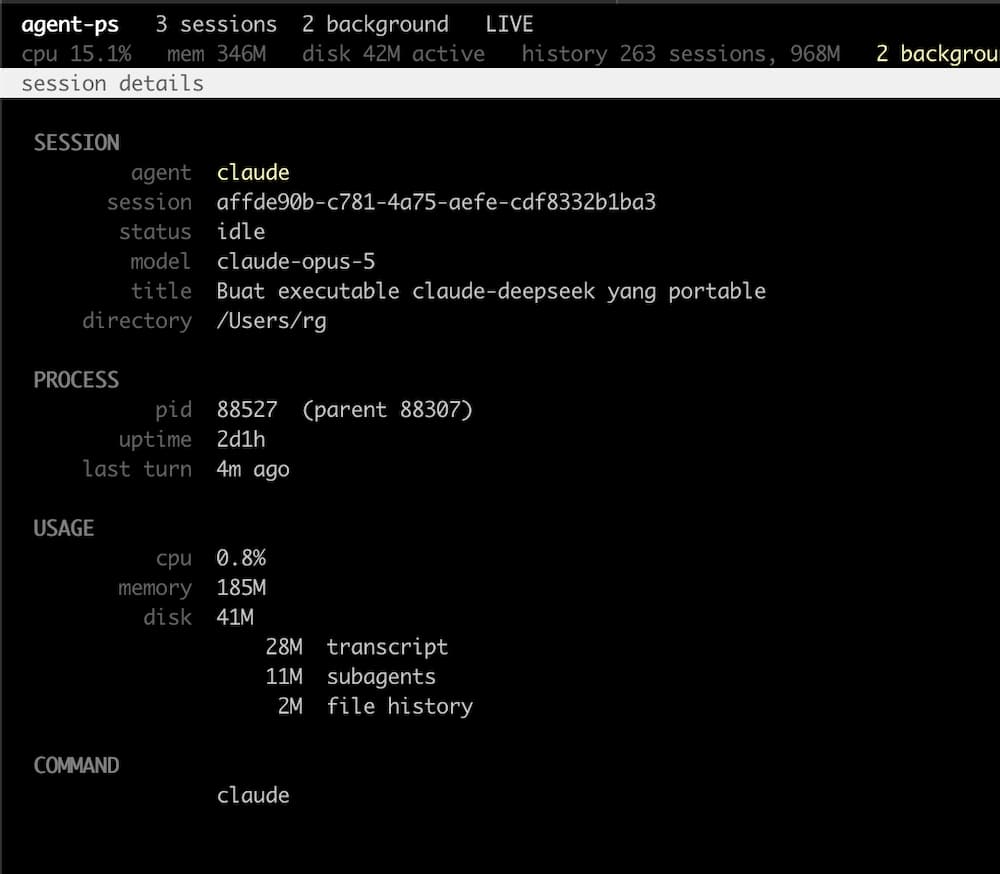
The disk total is broken down by what is holding it, since transcript and file history call for different answers.
Tokens and cost are here too, and Copilot reports the credits a turn spent:
    provider  opencode-free
      tokens  in 24,608  out 242  reasoning 190
       calls  2 api, 6 messages, 0 tool calls
        cost  $0.0000 estimated
A paired line appears when the session was matched to the process by working
directory rather than reported, so you know before pressing k that the pairing
is a guess.
Enter on an ended session reopens it in a new terminal tab instead. Copilot chats reopen in the editor.
A line above the keys points out whatever is worth a look: background helpers left running, sessions untouched for a day, or ended sessions you could resume. It names the key that acts on it, and shows one thing at a time.
agent-ps list                     # print the table and exit
agent-ps list --all               # include ended sessions
agent-ps list --json              # machine readable, with idle seconds
agent-ps list --limit 100         # how many ended sessions (default 40)
agent-ps list --filter benchmark  # same match as the / key
agent-ps prune                    # what ended sessions left, minus the conversation
agent-ps prune --older-than 30d   # only sessions idle that long (default 7d)
agent-ps prune --apply            # actually remove it
agent-ps agents                   # which agents were found, and where
agent-ps --agent codex list       # one agent, or a comma separated list
agent-ps stop 32244               # stop one process tree
agent-ps stop 32244 --dry-run     # show what would be stopped
agent-ps stop-background          # stop daemons, warm spares, and servers
agent-ps stop-background --dry-run
agent-ps resume <session>         # a unique id prefix is enough
agent-ps resume <session> --print # print the command instead of running it
agent-ps --version
Piping works without a subcommand: with stdout not a terminal, agent-ps prints the table and exits.
A session writes more than its conversation. Claude Code alone keeps subagent
transcripts, file history for /rewind, task records and a session
environment, and on this machine those came to a fifth of everything on disk.
agent-ps pruneReports and removes nothing. It lists what ended sessions left behind, grouped
by what it is and which sessions hold the most, and --apply removes it.
In the table, p does the same for the row you are on, and the detail panel
marks which parts of a session those are. On a session that is still running it
refuses and says why rather than going quiet.
Three things it will not do. It never touches a transcript, so every session
stays resumable. It never touches a session with a running process, whatever
its age, because file history is what /rewind reaches for. And it never
touches OpenCode, Copilot or Antigravity, whose sessions are rows in a database
the agent may have open: agent-ps reads, and does not write, the stores it
did not create.
| Column | Meaning |
|---|---|
| PID | the process, or a dash where there is none |
| AGENT | which agent, and what sort of process when it is not a plain session |
| SESSION | the directory the session was started in |
| STATUS | busy, idle, ended, or a dash when nothing says |
| MODEL | what answered the last turn, or the launcher's routing alias |
| UPTIME | how long the process has been alive, from one ps call |
| ACTIVE | how long since the session last wrote a turn |
| CPU, MEM | the same ps call |
| DISK | everything that session left on disk |
| DIR | the working directory |
| TITLE | the session title, or its opening prompt |
UPTIME and ACTIVE often disagree: a process can be five days old and have answered a minute ago. UPTIME comes from the process table, ACTIVE from the log, which is appended on every turn.
Each agent has its own colour, and the legend above the keys is the key to it. Terminals without colour fall back to plain text.
Only Claude Code records which process is running which session, in
<config dir>/sessions/<pid>.json. For every other agent the two have to be
matched on working directory, and that cannot tell apart two sessions of the same
agent started in the same folder.
So an inferred pairing is shown as one:
32244   claude    form-guardian   idle   opus-5        ...
9666?   codex     agent-ps        idle   gpt-5.6-luna  ...
9666? means the process is certain and the session beside it is a guess. The
guess is the most recently active session in that directory, and where several
processes of one agent share a directory they are paired newest with newest, so
the process that started four minutes ago gets the session that has been active
for four minutes rather than the one from an hour ago.
It is still a guess, so the stop confirmation names the directory and says when the pairing was inferred:
Stop 1 process(es) in ~/projects/agent-ps, session matched by directory?
Where no session matches at all, the row still appears with whatever the process itself can answer. Nothing is invented to fill the gap.
The parts that are not obvious have their own page: where each agent keeps its sessions, how busy and idle are decided per agent, which processes count as background helpers, how a shim is told apart from a real session, and what the DISK column is adding up.
Processes are stopped depth first, children before parents, so a supervisor does
not restart a worker you just killed. Each process gets SIGTERM, one second to
exit, then SIGKILL if it is still there.
agent-ps never lists or stops itself, or the shell that launched it, so running it from inside an agent session is safe.
Exit status is zero when everything asked for was stopped, and one when something survived, which makes it usable in scripts.
| Symptom | Cause |
|---|---|
| An agent you use is not listed | agent-ps only looks in the roots above. agent-ps agents prints what it found. |
| SESSION and MODEL are dashes on macOS | pairing needs lsof to read a process working directory. Linux reads /proc. |
| A row paired to the wrong session | see the question mark section above |
| No colour | the terminal reported none, so every row falls back to plain text |
| A Copilot chat has no PID | it never had one. Copilot runs inside VS Code. |
The executable is a zipapp, built from the package by the standard library:
./build.shThat writes a single agent-ps file with no dependencies, which is what the curl
install fetches. The build is reproducible: the same source always produces the
same bytes, so the committed executable can be checked against the tree.
fb81708bdedfee2dea7f83bf92cc3b4f32596a02af7d2e6383c92acd57790a4b agent-ps
Adding an agent takes one class and one line in the registry. See CONTRIBUTING.md.
MIT. See LICENSE.